Tuesday, October 7, 2025


Thursday, March 7, 2019
Why Don't We Just Open Up Empty Homes to Shelter the Homeless?
I have had people living in my dwellings for 30 years, and am looking to do it again. However, this isn’t a casual undertaking and must be considered with wisdom.
I allowed people live in my house after I knew them and their habits well. I didn’t just open up a house and let anyone stay there. There are some who live on the street who have a philosophy of damaging property, any property. And there are some who will steal. Let’s face it, there are bad people out there, and it requires wisdom and effort to discover who should be allowed in a house.
A single house can hold a number of people, but if they don’t get along then violence can occur. Or the house could be used as a place to sell or make illegal drugs. It wouldn’t help anyone if the house was condemned because of criminal activity.
Generally, a house to provide shelter for the homeless needs a manager who will uphold the desires of the owner and prevent criminal activity. This person or these persons will need to be paid. Insurance will have to be obtained.
To house people isn’t a light undertaking. Certainly not something we just want to open doors and offer freely. Many vacant homes are vacation spots or shelters for emergencies, and the owner will want to make sure that the home is in the same condition in which they left it.
To house people is an expesnive, somewhat risky undertaking. It isn’t for everyone. However, we need more people doing it than are, currently
Unethical Panhandling?

Is it morally unethical to ask for money because you’re homeless, yet you have the money to afford rent and are too lazy to get a job?
Answer:
Answer:
- If a person claims to be homeless when looking for help but they are not, then that is lying and so unethical.
- Panhandling while not homeless is ethical, as it is just a means for people to ask for support. I’ve seen fathers go on the street and hold signs asking for help for their electric bill. As long as people are honest.
- If you want to hold a sign, but not tell your story, the sign can read, “Anything helps” and hold it proudly. Then you are asking, but not lying.
- Flying a sign doesn’t make very much money. Maybe 30 dollars a day, if you have a good demographic. (women and people with animals receive more). Tough to pay rent on that.
- Flying a sign isn’t easy. Emotionally, it’s as hard as a job, and if you want to pay rent with it, you’d have to do it every day. Frankly, getting a job is more lucrative and often less work, even temporary labor. Almost all people who fly a sign do so because they can’t get work, not because they’re lazy.
Wednesday, July 18, 2018
Using Police as a Strategy

Memories…
-When six police officers came to my church, handcuffed and seated ten people in the parking lot and threatened them verbally. Ten more officers came, with their lieutenant, who asked me, “Are you the pastor? Does your congregation want people like this here?” I pointed at all the people they had handcuffed and said, “They ARE my congregation.” The lieutenant turned to his officers and said, “We aren’t wanted here, let’s go” and they all released the folks and left. But not before the officer who started it all screamed at my face for “enabling these criminals.”
-The time an officer came to my church, harassing someone on my property. I calmly informed him that people who threaten others aren’t allowed on the property and he would have to stop or leave. He turned on me and said, “Sanctuary, what kind of a name is that”? I said, “It means a place that is safe for people to honor God.” “You mean safe from the authorities?” “Safe from anyone who threatens their well-being.” He huffed off.
-The time a group of officers came to move someone off of our property and they handcuffed and threatened the person in question. I told them not to threaten or harm him. An officer replied to me, “If you really want to help him, you’d send him to jail.” I replied, “Jail isn’t what he needs. He needs the freedom and opportunity to choose mercy and kindness. Jail takes away all choices, not allowing for any real change to happen.”
-An officer comes to our property during a winter shelter and asks if there are any problems. “No problems,” I say, “We work things out ourselves here.” “Well, if you need any help,” he says, “Be sure to call us. We are here to help you workers, not these people,” he points to houseless folk smoking beside the church.
* * *
Some politicians think the solution to homelessness is more police, better police, even arrests. However, poverty is never reduced by police work, no matter how good. The very nature of a police officer is the threat they carry to force one to do their will. What homeless folks need, more than anything, is space to make their own positive decisions. They can’t make positive decisions unless they have the freedom to make decisions. Jail, the justice system, police accusations, arrests take away decisions from those who have too few choices to begin with.
-When six police officers came to my church, handcuffed and seated ten people in the parking lot and threatened them verbally. Ten more officers came, with their lieutenant, who asked me, “Are you the pastor? Does your congregation want people like this here?” I pointed at all the people they had handcuffed and said, “They ARE my congregation.” The lieutenant turned to his officers and said, “We aren’t wanted here, let’s go” and they all released the folks and left. But not before the officer who started it all screamed at my face for “enabling these criminals.”
-The time an officer came to my church, harassing someone on my property. I calmly informed him that people who threaten others aren’t allowed on the property and he would have to stop or leave. He turned on me and said, “Sanctuary, what kind of a name is that”? I said, “It means a place that is safe for people to honor God.” “You mean safe from the authorities?” “Safe from anyone who threatens their well-being.” He huffed off.
-The time a group of officers came to move someone off of our property and they handcuffed and threatened the person in question. I told them not to threaten or harm him. An officer replied to me, “If you really want to help him, you’d send him to jail.” I replied, “Jail isn’t what he needs. He needs the freedom and opportunity to choose mercy and kindness. Jail takes away all choices, not allowing for any real change to happen.”
-An officer comes to our property during a winter shelter and asks if there are any problems. “No problems,” I say, “We work things out ourselves here.” “Well, if you need any help,” he says, “Be sure to call us. We are here to help you workers, not these people,” he points to houseless folk smoking beside the church.
* * *
Some politicians think the solution to homelessness is more police, better police, even arrests. However, poverty is never reduced by police work, no matter how good. The very nature of a police officer is the threat they carry to force one to do their will. What homeless folks need, more than anything, is space to make their own positive decisions. They can’t make positive decisions unless they have the freedom to make decisions. Jail, the justice system, police accusations, arrests take away decisions from those who have too few choices to begin with.
When you are looking for a group to be the frontline for solving a city’s homeless issues, the police is the last group to use. There is no reason to take the group that accuse families and the struggling of being criminals and make them the face of the city to the homeless. This approach only increases a person’s stay on the street.
Tuesday, May 22, 2018
All the Things

The mayor of Portland took one look at a village, an opportunity for people on the street to get some stability and a path off the street and he said, "No effing way," and sent his police to clear us all out. We can shake our heads or cry out against him for his rejection of a positive way of providing real help for houseless folks.
But any advocate who rejects the plans of the county or of business people or of neighborhoods to do what they can, how are they any better? Sure, administration is imperfect, placement is imperfect, it doesn't work for everyone on the street, but I've heard very few plans that doesn't help enough people on the street to make the effort worthwhile. As for the imperfections, rather than rejecting the effort, let's work with people to improve their work.
We are in an emergency. We can't afford to reject efforts. We need them all.
Wednesday, May 16, 2018
How Do Houseless Folks Obtain State ID?

1. Birth certificates are the main form of proof. If one doesn't have this, they must obtain it from the county of their birth. This is easiest to get if one has an immediate family member obtain it for them. To get it otherwise, one has to have other kinds of proof, such as an affidavit from a person who knows who they are, signed before a notary public. Other kinds of proof could be military records or jail/prison records.
2. Generally a person proves their address by giving a piece of mail from an address. But what address? P.O. Boxes aren't accepted. In most cities there are churches or non-profit organizations who will act as an address for people who live on the street.
3. Many cities have organizations that provide finances to obtain state ID. Check a local shelter or day shelter if they have any information about help in this area.
There is also a possibility that if a person is still in the system, a copy of their ID might be provided with a minimum proof, as they have a picture and signature of the individual in their system. Check with your state DMV for more information on this.
Saturday, May 12, 2018
How do Houseless Folks Affect the Economy?

Houseless folks add to the economy in many ways. Forty percent of houseless folks have jobs, others are active in recycling, and all of them participate in paying sales tax.
The real economic drain comes in health expenses. Many houseless have no health insurance, and emergency room visits are a huge expense. Living in the rough is unhealthy and most the average year of death of houseless folks is 48, before that end, many have expensive procedures.
It is considerably cheaper for a society to provide housing than to treat people who live on the street. The economy would improve, and we would have more citizens involved in our community, if all who wanted to be housed could be.
Thursday, May 10, 2018
Why are so many Homeless Addicted?
 |
| Homeless Resource Network |
It is often assumed that houseless folks become homeless due to drugs and alcohol, which is why there are so many people we see using such items on the street.
However, it has been shown that approximately fourteen percent of those on the street lost their housing due to substance abuse. As a person is on the street longer, the more likely it is that they will be addicted to a drug. Chronic houseless individuals are much more likely to be addicted than a person on the street for a year or less.
This is because drugs or alcohol are being used as a way to ease the pain of living on the street, especially if they are regularly harassed and abused. Up to 80 percent of homeless youth use substances to deal with the trauma they experience every day.
I have found again and again that many houseless individuals or couples find it a fair exchange to drop their substance abuse for stability and opportunities for a new life. This isn’t true of everyone, as the street is also the only reliable depot of those our society considers unacceptable. But we need to stop considering substance abuse as a personal failure and instead see it as a health issue in our society.
Reference: National Coalition on the Homeless, http://www.nationalhomeless.org/factsheets/addiction.pdf
Reference: National Coalition on the Homeless, http://www.nationalhomeless.org/factsheets/addiction.pdf
Thursday, August 10, 2017
Why Hasn't Poverty Been Eliminated?

- Poverty is personal. There are many factors that are the causes of poverty: war, disease, lack of clean water, inadequate housing, insufficient land. We don’t actually have enough information on most poor households to know what makes them poor to create a plan which accurately will eliminate poverty. Ending poverty begins with listening to the poor and then dealing with their issues.
- Poverty is social. Many people will figure out a way to live with what resources they have, but people who see them bring them down. There are people in slums or people who are homeless who are content with their lives. But others see them as disgusting or living in squalor, and that brings them down.
- Lack of will and organization. There would have to be a determined, coordinated effort by tens of thousands of organizations to make the end of poverty happen. This requires a surrender of organization’s personal goals to make it happen. No one really wants to do that. They’d rather see their ideals happen.
Thursday, August 3, 2017
What Should I Do About Homeless In My Neighborhood?
 |
| Tim, nicest guy ever |
Perhaps that's true. Or maybe it's not. Folks on the street are, more often than not, citizens of our town, of our neighborhood. They just don't have a place they own. So local public property is the only place they have.
What if we don't like them in our neighborhood? We need to deal with them, and ourselves. But calling the police is a bad idea. First, because we should really be calling the police for criminal activity, that is what they are trained for. Also because it puts them in the uncomfortable situation of being someone else's babysitter. If someone is trespassing on your personal property, then you can call the police. But no matter how much I wish I could, it's not right for me to call someone for parking on the street in front of my house. Even so, no one should be calling the police because homeless folks are on public property.
Here are some things that I did about the homeless in my neighborhood.
- I invited homeless folks to my house, to eat dinner with my family. I listened to them to understand their perspective and their lives. While some disturbed me, others became my friends.
- Talking to the city about giving space for them to be. Perhaps I don’t want some of these folks sleeping in my neighborhood (if they were noisy at night or whatever), but they have molecules so they have to be somewhere. So I spoke to city hall and the mayor and worked with them to create a piece of unused property that they could stay, even if only temporarily. I helped a homeless camp organize and establish rules for their camp. They were able to live peacefully for months there.
- Some of the folks, after I got to know them well and could trust them, I invited into my house to live with me and my family. I established rules and work for them to do and they lived with us for a while until they could get another place set up. This option isn’t for everyone, and it isn’t for every person who lives on the street, but if one gets the right “match” it can work out well.
Thursday, July 6, 2017
Preparing for the Destination

"The second traveler is less careful, not so meticulous in planning the trip and, as a result, will encounter delays, disruptions and even despair. When disappointments mount to intolerable proportions, this traveler may even give up and return home, defeated. We learn from this example to either prepare well or stay at home.
"It is the third, the desperate traveler who teaches us the most profound lesson and affords us the most exquisite thrills. She touches us with her boldness and vulnerability, for her sole perpetration is the fierce determination to leave wherever she is and her only certain destination is somewhere other than where she has been."
-Maya Angelou
Sunday, July 2, 2017
Save Addicts

Bill Thompson is an ambulance driver and EMT in Illinois. He is also a big-hearted man who I am proud to know. And he wrote something that has been dear to my heart for a long time:
"The longer I spend in this field the more I realize I have to be a champion for addicts. Seems like every day lately I overhear, or take part in, a conversation that centers around addiction.
"The points being offered are usually the same, 1) Addicts aren't as good as the rest of us, 2) They choose to be addicts, and 3) Why is it our responsibility to save them?
"All three are points that make me want to punch a hole in a wall.
"1) Addicts are the same as everyone else. They are people, and I guarantee all of us are surrounded by recovered, or active, addicts and we have no idea. If anything, if we choose to turn our backs on those suffering from addiction then we aren't as good as they are.
"2) No one chooses to be an addict. The science bears this out, but beyond that, if you really think someone chooses to lose control and alienate those who care about them, I don't know how best to respond to that
"3) We can't save addicts. We can keep them alive, we can help them. That's the most we can do, and we do it because we are human beings. The person addicted to heroin is still a person, and it's my responsibility as a human being to help my fellow man, when I am able.
"Very few of you will read this, but this is a topic I care more about every day, and I'm not backing down."
Sunday, June 4, 2017
Sweeps Don't Work

Why sweeps don't work:
1. You can't use a stick to motivate someone who is beaten regularly
2. Homeless folks have molecules. If you move them from one space, they will have to take up another.
3. If neighbors complain about the homeless being under the freeway, they would like them worse on the sidewalk in front of their house.
4. To move homeless folks around means that they are more difficult for service agencies to find them, to help them and so to get them off the street.
5. 40 percent of homeless folks work, and forcing them to move on a regular basis threatens their ability to hold down a job.
Can you think of any more?
Friday, June 2, 2017
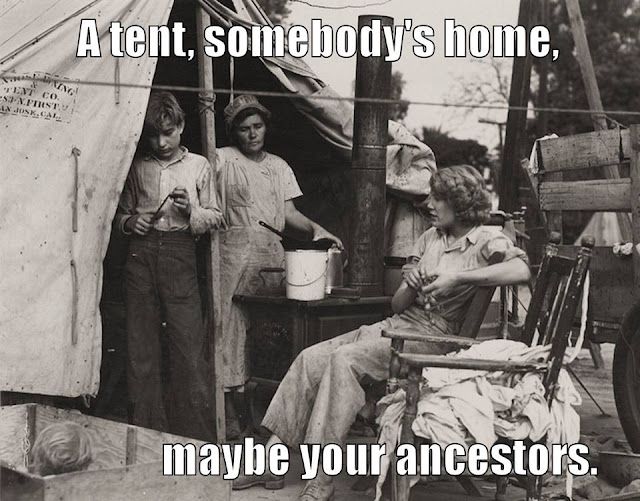
Tent Living
To deny people the opportunity to live in a tent is to deny an ancient way of life. A healthy city allows for a variety ways of life, a variety of means of survival, according to a person's means.

Monday, May 29, 2017
Commitment
“I will always be on the side of those who have nothing and
who are not even allowed to enjoy the nothing they have in peace.”
—Federico
García Lorca
The Time Had Come

"The 'cleaners' are threatening to take an old persons walker. An old mans cart. A back pack because they are on the sidewalk next to my house and the sidewalk was posted. They threatened me with the cops. I moved my home and he told me to move it again he is going to cause me problems.
"Silently the homeless move down the road. Small groups and single people breaking off going in different directions. No communication. Just a sense of loss. A sense of defeat and anger. Shoulders slumped and heads down. They keep walking trying to just remember why they even bothered to wake this morning. Each one lost in their own thoughts their own devastation. Finally they look up and see how far they have come only to realize that even as far as they have come they will only have a few hours rest if that. They set down their heavy loads and Finally look at one another realizing that not a one of them can keep moving. The time had come for them to make their stand. It was time to stand and fight. No more flight."
-L. Karen Burch, living in an RV on the streets of Portland, watching her friends in tents be forced to move, even though their spaces were clean and on public sidewalks
Monday, February 6, 2017
Homelessness and Drug Addiction
 |
| If you see a bunny, you may be addicted. |
I posted on Facebook recently that homeless folks were just as worthy as other folks, just in a different situation. I received a rebuttal from another person, having met at least one homeless person. His response could be summarized thus:
All homeless folks use drugs.
Drug users are weak and thieves.
Therefore, these are less worthy than others.
Drug users are weak and thieves.
Therefore, these are less worthy than others.
Well, I know a number of homeless folks who do not use drugs, not addicted to anything, and I know a number of drug users (also homeless) who are not thieves. But there is a stereotype there that has some truth to it. Allow me to unpack a general trend of the homeless and addiction.
According to the National Coalition for the Homeless, approximately nine percent of people who become homeless do so because of addictions. This doesn’t mean that others aren’t addicts, but it wasn’t their addiction that caused their homelessness. So let’s just say that 15-20 percent of people become homeless with an addiction. What everyone agrees on is that most people aren’t addicts when they become homeless.
The far majority of them. Approximately 70 percent of all people who become homeless every year find housing in less than a year, most of them in a few months. Most of these people certainly didn’t get housing maintaining or increasing their addictions. A few did. But most of them were never addicted to begin with and some gave up or reduced their addictions to meet their goals.
What about the rest? Well, the people who are generally considered “homeless” are those who have been on the street for more than a year. These are the folks who have been without a decent night’s sleep for at least a year. These are the folks forced to move, with everything they own, sometimes more than once a day. These are the folks who tried to get work, to get into school, to find a place to live until they had given up hope for themselves. These are the folks who have had their possessions stolen. These are the people who have nothing left but regret.
So almost all of these folks who are chronically homeless are also sufferers of chronic stress. And since they have no tomorrow, they need to forget. And drugs or alcohol offer that way out.
Again, not everyone takes that way out. Not everyone wants to be seen as the wino, the bum on the corner. Or, I should say, some folks have enough self-respect left to care what people think about them, so they do all they can to avoid that most disgusting, most degrading of American occupations. The man openly drinking a 40 ounce outside a convenience store, who is shooting up in a public restroom are really the only ones who have no self-respect left to give in this country. They really don’t care, because they’ve lost everything.
This is why people who think that folks in this state need a few months to brush themselves off and get out there and struggle for their sobriety, their self-respect and their survival don’t really understand the state of the chronically homeless, especially those who are addicted. It took at least a year, possibly years, to drive a person into abject hopelessness. It will take some time to climb out. I think of the way out as stepping stones.
1. Self-respect This stage will only happen when a person receives respect that they didn’t necessarily deserve. When they see others respecting them by giving them kindness and opportunities for hope, they will think that maybe their view of themselves need to change, and they want to earn the respect they are receiving.
2. Better living When they see themselves as someone who wants to live, they will see the squalor they live in, and want to improve their state. That desire doesn’t do anything unless they also have a hand up, because one cannot jump out of the ditch of homelessness themselves. But they will accept that hand, because they see the necessity of it. They may accept a place in a village, a spot in a treatment center, a place in a shelter they trust, so they could get a better life.
3. Strength But most people who are chronically homeless will fail at their first attempts to improve their life. Some are out of practice, some are unlucky, some are too sensitive to disrespect, some have mental health issues and some have physical health issues. It will require inner strength for them to try again. Some have it, and some don’t.
4. Progress One step leads to another, even if there are missteps. Entering into treatment sometimes leads to housing and outpatient treatment and possibly a job. Entering a wet village can later lead to living in a less chaotic dry village, which can lead to a job and permanent housing. Entering into a shelter can lead to a part time job and then a full time job and housing. No one’s path is the same. And the first step of progress can, with strength, lead to the next one.
My point is, everyone is worthy. People are worthy. The person you see as a worthless drug addict on the corner is worthy, and we can have hope for her even if she does not have hope for herself. A wino doesn’t have to live that way. But they will unless two things happen. Someone gives them respect. And someone gives them a chance.
Friday, February 3, 2017
Karen on the Street: Slow Motion
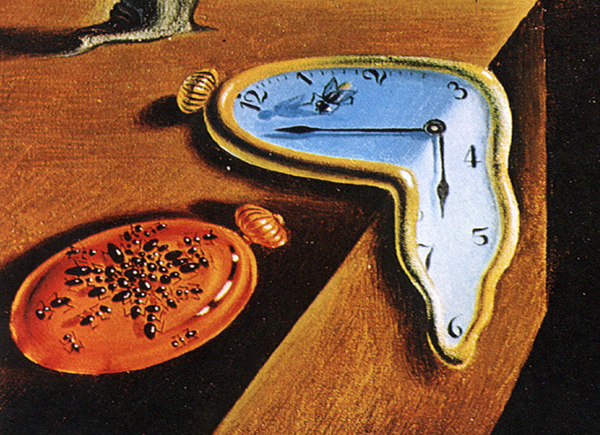
You lose track of days and weeks at a time. Time becomes what you can get done in a day.
Get up, get ready, sometimes you take time for breakfast sometimes you don't cereal and milk are easy if you have it... Or you take time and cook...
Then you start traveling either to a job you have that day or appointments or hunting down what you need to survive food and such...
Getting money at some point to get the things you needs... Propane, gas, cigs, etc.. etc.. Charging things....
On top of that if you have animals you have their needs also. Some people say the homeless shouldn't have animals but our animals are sometimes the only thing that keeps you going. They depend on you to survive.
Then you have your times where time hurries by where you can't seem to get anything done and there is so much to do.
I know these things happen when you live in a house too but they really are different. Remember frontier days. Sometimes it takes a toll on a person and what they are trying to do to go forward. For every one step forward something takes you about ten steps back from where you were.
You take it in stride or you break to the streets and go off the deep end. Each person is different in how they handle it.
-Karen Burch
Why Statistics about Homeless Folks are Tricky

We want statistics, because we want to quantify "the problem", which is homelessness. If we can box it, measure it, then we can reduce it or eradicate it. Were it so simple. Homelessness isn't something we can distinctly measure and wipe off the map. So much of homelessness is an attitude, both of the homeless and of housed neighbors. And trying to measure homeless folks is like trying to count the drops of water in the ocean.
Here are some of the issues those who gather statistics have:
1. Homeless folks don't want to be found
In many cities, homeless folks and camps are targets. Targets of the police, of housed neighbors, of people who take advantage of them, of highway workers and others. Many groups automatically see them as criminals, or at least as "undesirables." Folks on the street who would like to live a peaceful life find that hiding is the best way to do it. If the police can't find them, then the likelihood is that those who wish to count the homeless can't find them, either.
2. Street numbers change
Not only do the numbers of homeless change from year to year, they change from month to month. Most of the homeless have family, friends or jobs that will help them get off the street. Sometimes the right friend just finds out, a family member's heart is tugged just right, or a family just needs to save enough money. In the summer, friends and family feel less for those on the street than in the winter. And there are cycles of time when landlords evict their tenants, and times when they don't. If certain government programs for the ill, the mentally ill or the poor are cut, then homelessness increases. On the other hand, if shelters or programs develop, homelessness might decrease. Or it might not. So a single count every two years is woefully inadequate to give us a picture of homelessness at any other time.
3. Who counts as homeless?
Finally, statistics are remarkably different depending on who is being counted. Recently, the Department of Housing and Urban Development posted statistics about Homelessness, counting only those who are on the street. The Point in Time count every other year counts people sleeping on the street, those in their cars and those in shelters. Others will count those forced to live in motels, on friend's couches or in other overcrowded situations. Some will actually compare one group with another to try to show that they have almost eradicated homelessness. Utah, for example, was able to claim that they reduced homelessness by 91 percent by changing the definition of who is "chronically homeless". So numbers might not make sense, especially compared from one agency to another.
We need the statistics in order to give us a general idea of the scope of the issues involved, or to determine trends. But exact counts are not possible, unfortunately.
Wednesday, February 1, 2017
"Get a Job"

Little does the man in the SUV know that he is playing a role with medieval origins.
The concept that the poor are lazy is a very old one. In the middle ages, the world was divided primarily between lords and serfs. Lords owned all the land, serfs rented a portion in order to make their living. If they didn't make enough money from their produce that year, their land was taken from them and they were destitute.
Even so, serfs didn't work very hard. They were often considered "lazy" by their lords, who would randomly go and beat them in order to make them work. Of course, they had no incentive to work hard. Their life wasn't going to improve, no matter what they did. They would sometimes take the biblical advice to get drunk in order to forget their harsh lives. This only infuriated their masters more.
The feudal system slowly broke down during the industrial age, and serfs left their forefather's land in order to make a better life in cities. However, they found much the same system, divided into hours when they used to have years. They were still disrespected for a lack of work because they showed up late, because they took rest in the midst of their labors.
Many were fired from their jobs and they would loiter outside, trying to sell what little resources they had. This meant that they had a serious issue: they did not have "real" work because they did not have an employer, a lord, or a master to tell them what to do with their time. All they did was survive, which wasn't good enough in a land with lords.
In London, many of these "loiterers" were gathered up en mass and sent to North America to work on plantations or as servants. Some were offered the opportunity to have a lesser pick of lands themselves, but by the early eighteenth century, that opportunity dried up unless one dared the savage lands of the West. Those who remained had to find a lord or scrape up a living on their own. Those who didn't obtain a master, or didn't become successful through entrepreneurship were called "lazy" and often shamed in public.
All along, these people were granted insufficient incentive and high shame no matter what they did.
The one today, who tells the man on the street "get a job" is enacting the role of the upper class, telling one of the poor class to obtain a master. Because survival is insufficient a goal for those in a land of masters and servants.
Subscribe to:
Posts (Atom)