Showing posts with label Meet the Anawim. Show all posts

Thursday, May 21, 2015

Presence When You Can't Understand

No one could comprehend Melisa.  Her sentences were complete non sequiturs,  without context, even though she looked straight at her questioner, and seemed to be a clear answer.  She always knew where she was.  She had a regular schedule.  The AA meeting every morning, to get some coffee.  The soup kitchen most afternoons, except on Saturday when she ate at the church. She would sleep with a male friend who wanted to keep her safe.  There was no hanky-panky, she wouldn’t allow that.  But despite her regularity, she was a mystery.

Rachel, a member of a local church, couldn’t understand Melisa any better than anyone else.  But she took a shine to the homeless woman, and invited her to church.  She wasn’t sure if Melisa wanted to go or not, but arranged to pick her up at the morning AA meeting anyway and brought her along.  Melisa didn’t seem to mind, nor did she seem to get anything out of it.  She sat in her chair, next to Rachel, looking around, everywhere but up front.

The next week, Rachel picked Melisa up at the Saturday church meal and took her to get some clothes.  Melisa at first didn’t seem to know what was going on, but when Rachel gave her options, Melisa chose what she wanted and tried them on.  It took a couple hours, but Melisa had a new outfit. 

Every week Rachel met Melisa at the AA meeting and took her to church.  Sometimes she took the homeless woman out to eat at a fast food place.  Occasionally Melisa would wander off, but she was always at the AA meeting, every Sunday morning, and Melisa never objected to Rachel picking her up.

One day, Rachel asked other homeless folk where Melisa camped.  She met the friend who she camped with and said that she’d like to movie Melisa into her home.  Michael, the homeless man, was surprised, but glad that someone took an interest in her friend.  He encouraged Melisa to stay with Rachel, and he and Melisa gathered up her things and put them in Rachel’s car.  Rachel then put Melisa’s things next to her living room couch in her apartment, and Melisa spent the night there.
The next day, Rachel drove Melisa to the social security office, where they spent hours helping Melisa apply for Disability.  Eventually, the agency sent Melisa to a psychiatrist for an evaluation and she was diagnosed with schizophrenia.  The psychiatrist also gave her a prescription, which neither she nor Rachel could pay to fill.   After a couple months, her insurance kicked in, and the medication was obtained.

And Melisa started to change.  It took time, but eventually she began to answer questions directly.  She understood what was happening around her.  She stopped looking up, and could focus on a person’s face, or the front of the church.  She was able to tell the story of her family, how her disability check was taken every month by her sister, who made her sleep in the backyard.   How she went to the AA meeting every morning, not because she was an alcoholic, but because she liked the coffee they served.


Melisa stayed on Rachel’s couch for years.  She became more able to make her own decisions and eventually moved out into her own place.  One day, Melisa decided that she was doing well enough that she didn’t need her medications anymore.  After a couple weeks, when she met George Washington at the door, she decided that she needed her medications after all.  

Thursday, April 30, 2015

Transforming Grace

Trevor was a young man when he became homeless.  He had worked a few jobs, but it was hard to stay with any of them.  As long as he could remember, he was struggling with himself.  He would become furious with his mother.  There were good reasons, always, for him to be angry, but his response seemed over the top.  He would rage, throw things, break things, and people would back off, fear him.  That was somewhat satisfying, but he was as scared of himself as his family was.  His mother would tell him that he was a bad boy, his father would express his disappointment in him.
When he became homeless, his family fully expected it.  They figured he would be a criminal or a bum. It’s the kind of person he was.  So they offered him help, but at a distance.  They would invite him to family gatherings, and most of the time they wouldn’t show up to get him as they said they would.  They didn’t know how to handle him.

Even after Trevor had been camping for a long time, he liked to work.  He wanted the respect and pay of a job well done.  He would clean up bars after they were closed, for nothing.  To work eased his mind, gave him something to focus on apart from himself.  He needed that.  Because he couldn’t stand himself.  He felt he was a good person, but he couldn’t help but look back and see all the mistakes, all the people yelling at him, all the problems he had caused.

Darren was a pastor of a local church.  He allowed Trevor to sleep overnight behind the church on occasion.  Trevor asked to help clean up, to care for the facility, and Darren figured there was no harm in it.  Trevor did a fantastic job.  Every task he was given he did with gusto and did more cleaning that he was originally asked.  Darren invited Trevor to stay behind the church every night, because he was a good man, and helpful.

Eventually, there were problems.  Trevor had a habit of collecting too much stuff around him, making his area look like a trash heap.  Darren gave him a garbage can and asked him to keep his area clean, and Trevor did his best.  People visited Trevor in the middle of the night, and Trevor would allow people to stay there overnight.  Eventually, Darren wrote out a contract with Trevor, clearly stating the rules of their agreement.  Trevor had to keep his area clean, and couldn’t have guests in his space, and if he wanted to talk to someone, they’d have to speak quietly or go off of the property.  After Darren explained the reasons why, Trevor understood and dealt with the issues.

Then Trevor had a bad day.  They didn’t come often, but when he had them, he was on the edge of exploding.  On this day, Darren happened to come upon him and told him firmly that he had to clean up his garbage.  Trevor started throwing all of his possessions at Darren, screaming, “How about this?  How about this?”  

Darren stood there, and calmly said, “Trevor, you need to calm down.”  

“How about you just leave me alone? Leave!”  

Darren stood firmly and said, “No, I won’t leave.”  

“Leave!  I’m going to hurt you!  You know I will!” 

Darren responded, “If you hurt me, I will still love you.  I will still do what I can for you.”  Another homeless person saw this and went to Trevor and calmed him down.

Trevor knew that he would be asked to leave now.  He wasn’t worthy.  He had screwed up another part of his life.  Another rejection because he was too weak.  Darren saw him the next morning and said, “Great, Trevor.  You got that area cleaned up.  Thanks for doing that. Did you need to come in and use the bathroom?”  Trevor realized that Darren wasn’t going to reject him, no matter what.  He is amazed at the grace he has been shown.  He didn’t know such people existed.

But word got around the church at Trevor’s explosion at Darren.  Many of the church members decided that Trevor was a danger.  What if he blew up at one of the church members?  What if he hurt someone, or put someone in the hospital?  The issue was brought up at a church board meeting, where they asked Darren, “How long will you have this man at the church?  He’s dangerous, and we don’t feel safe.”  

Darren responded, “I understand that having Trevor staying here is a risk.  You have to admit, as well, that he is an asset.  When have you seen the bathrooms or the kitchen so clean?  Every true act of grace is a risk.  To accept the difficult or the dangerous is hard and sometimes scary.  But this is what Jesus did for us.  He took us in, when we didn’t deserve it, when we were so much a risk to him that he died for us.  Grace isn’t something that we just receive.  It is something we pass on.”

When it was clear that Darren wouldn’t change his mind, the board was divided.  After much discussion, it was decide that they needed to make a vote as to whether Darren should still be pastor.  They took a formal vote, and the pastor was allowed to remain, by a narrow margin.  Some church members decided that they couldn’t be in a church that had a person like Trevor hanging around, so they left the church. Darren, meanwhile, carefully kept this all from Trevor, so he didn’t feel that is was another mark of rejection against him.


Trevor stayed at the church for years.  He had other explosions, but never with a member of the church.  He softened over the years and was accepted by everyone in the church as a full member.  Eventually, Trevor got a paying job and an apartment, which he kept a terrible mess all the time, but he always visited his friend Darren.

Monday, August 5, 2013

Mercy On His Soul

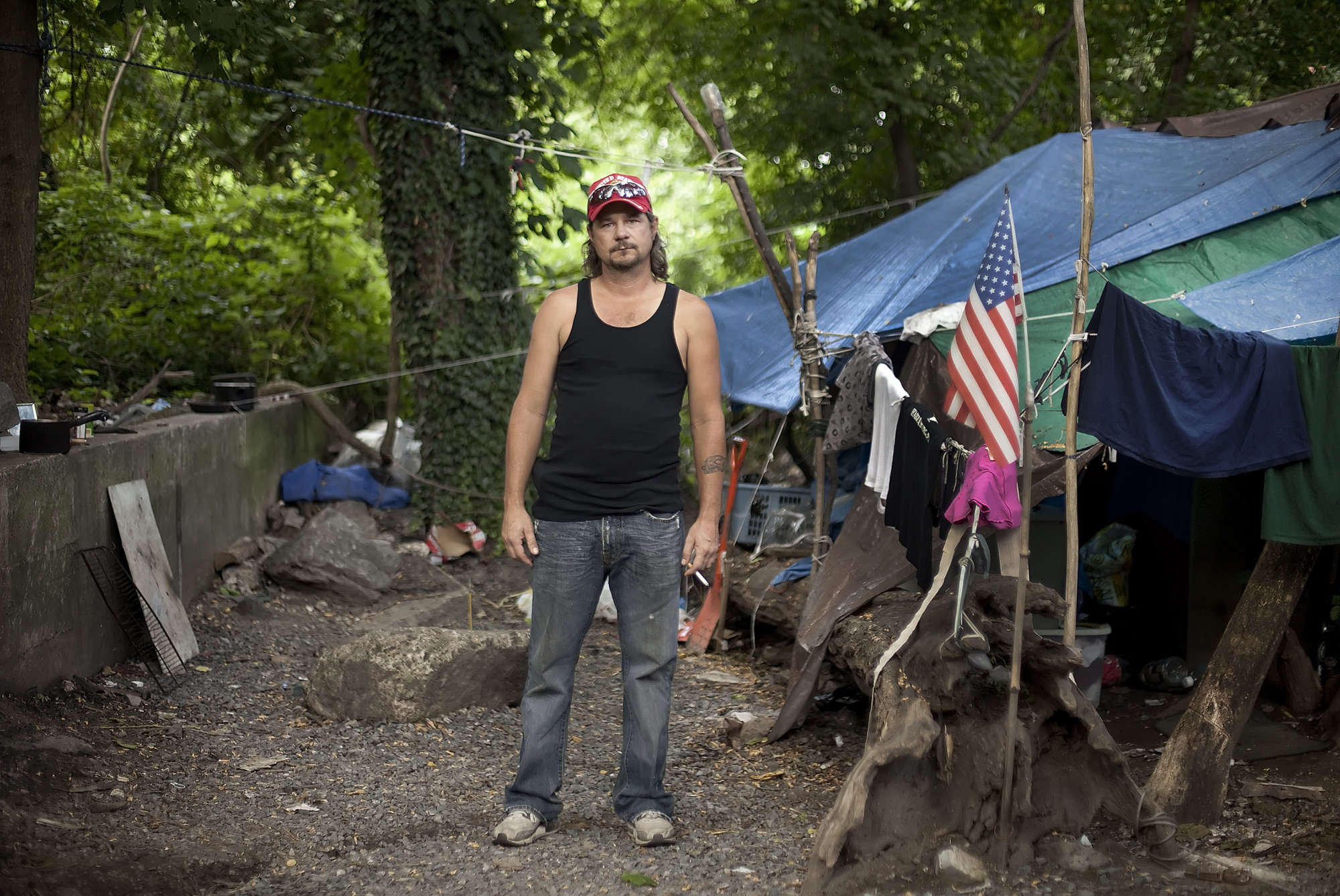
I don't have a picture of Buster or Bill, but he's a homeless guy
named Dennis.
Buster didn’t really like me.  I was new to the homeless scene and while he appreciated the food on occasion, he knew I was there to “save people’s souls” and he thought that I was as much use as a fourth leg on a tripod.  But what most of the homeless know is that a middle-class pastor is a connection to the outside world, and sometimes that connection is necessary.  And this day, Buster really needed me.

It must have been serious because I didn’t see Buster very often.  He had a long trek, perhaps two hours, to get to the church, but he was there.  After taking a breather, he approached me and said, “We need to talk.”  I was a bit mystified because Buster had never needed to “talk” to me before.  He talked about me, or at me, but never to me.  So we stepped aside into my “office” (the middle of a field) and he said, “It’s about Bill.”

Ah.  Bill was Buster’s camp-mate and drinking partner.  Bill was an older gentleman, with an emphasis on the gentleman.  He was always polite and kind, if a little self-absorbed. He had often showed up to church sober, only to have a seizure in the middle of the service.  (See the Homeless Pastor Hint below for what to do in that circumstance.) Over the year I knew him, Bill was gradually losing his sight.  At first he was losing his night vision, but it gradually became worse so that Buster was leading him to wherever he needed to go.  And after a month this, Buster needed to talk to me about Bill.  This can’t be good.

“He’s going crazy.  He’ll wake up in the middle of the night, screaming.  And he’s always talking to people who aren’t there.  He’ll wander off and fall.  I’m afraid he’s really going to hurt himself.   Could you get him into a hospital?”

“What kind of hospital, Buster?”

“He’s crazy.  He needs to be taken care of.”

“Well, I can’t put him in a hospital, but maybe I could talk to him and convince him to go to a hospital to get checked out, and they could make their own decision.”

“Sure, that would be great.”

So I got the directions to their camp (behind-the-store-down-the-street-end-of-the-cul-de-sac-behind-the-wall-next-to-the-ditch) and agreed to seek Bill out at about 8 in the morning.

A homeless camp in Harrisburg which is kinda like Buster
and Bill's camp.
It took me a minute to find the camp, but the directions were quite accurate.  At the end of the wall were three tents, next to the ditch.  I did typical camp ettiqute, calling out “Hello!” before I reached the camp. 
No response.  That was odd because Buster said he’d make sure Bill was there.  Perhaps Bill was still asleep, so I approached each of the tents, calling out his name.  After that got no response, I called out Buster’s name.  Nothing.

I wandered a bit further out.  I saw a neat pile of camping gear to one side.  Frankly, they kept a nice camp.  No piles of trash, and the bathroom spot out of sight.  That’s pretty good for a couple alcoholics.  My respect for Buster deepened.  He really knew how to live on the street.  Keep a low profile, keep your camp neat, be polite to neighbors and they’ll leave you alone.  And he was helping Bill all day, every day for months.  He was rough-spoken, but a good man.

But I was still mystified.  Perhaps Bill insisted to go with Buster.  I looked around once more and then I saw.
About twenty feet away from the tents was a concrete ditch.  And at the bottom of the ditch was a body, face down.

I climbed down the steep walls of the ditch, and shook the body.  “Bill… Bill?”  Nothing.  I turned his face.  Yep, it’s Bill.  His lips were pale.  His face was cold. 

I climbed out of the ditch, pulled out my cell phone and dialed 911.  “I think my friend is dead.  He’s at the bottom of a concrete ditch.”

Still not us.
A half hour later, after his death was confirmed, a police officer came up to me and said, “You don’t look good.  You’ve never done this before, huh?”  I hadn’t.   It wouldn’t be my last time calling in the coroner. 
I looked up then and saw Buster walking up, seeing me and all the emergency services activity and looking confused.   I went to him and just said, “He’s passed away, Buster.”  For the first and last time, Buster and I held on to each other, needing the others’ support.

A few days later I called the coroner and asked him how Bill had died, wondering if he had wandered in the night and hit his head.  “William didn’t die right away,” he said.  “Although he hit his head, he didn’t have any internal bleeding.  He died of hypothermia.”  He froze to death on the concrete in the middle of the night, just far enough away from the tents that no one could hear him calling.

Buster met me later in the week and handed me a phone number.  “This is the number of Bill’s sister-in-law.  His family is back East.  Could you give them a call and let them know?”  Of course.

Not her.
I call her and try to gently tell her the news.  

“So Bill was in Portland?”, she asked.  

Yes. 

“And he died of hypothermia at the bottom of a ditch?” 

Yes.  

“Good.  After what he did to this family, he deserves whatever he got.  You can be sure that I’ll let the family know and they’ll be happy about it.  I’m sure he’ll go to hell.  Thanks for your call.”  

And she hung up.

I have no idea what Bill did.  I know that he spent some time in prison for it and ran across the nation to escape the shame of it.  I suspect it was the shame that caused him to drink and to wake up in the middle of the night screaming, talking to people who weren’t there.  I’m not sure, but that’s what I think.

But Bill was mourned in Portland, if nowhere else.  We held a small memorial service.  And I know that the traditional homeless mourning ceremony was also held—his friends gathered together, scraped up money for a beer each, and they each poured out their beer on the ground in memory of their friend.  A drink and grain offering in memory of the dead. 


May God have mercy on his soul.  For few had mercy for him on earth. 

Sunday, April 10, 2011

Reference Letter for Tim and Sam

To Whom It May Concern:


Tim and Sam are people who have struggled to improve their lives. And they have succeeded.

Tim struggled through his addiction with drugs and homelessness. In the midst of his lowest points, he was in jail and he failed in treatment programs. In the midst of this, he remained cheerful and encouraging to his friends, but that doesn’t mean that internally he wasn’t fighting with the two parts of himself—addiction and self-control.

Tim has now been living in my house for over a year and he’s been clean and sober for almost two. He has had a full time job working for a printer for nine months. And this change is due to many reasons, but the two most important is his deep and abiding love for Jesus and his deep and abiding love for Sam and their daughter, Paloma.

Sam struggled with severe depression and a resulting addiction to alcohol. She lost her husband, her four children, and her apartment. She and Tim met each other in the midst of this time, introduced by a homeless friend, and they fell in love. They became homeless together for a short period of time, and Sam discovered that she was pregnant with Tim’s child.

Sam moved in with friends, and as the baby’s birth drew close, moved into my house. She is fully supported by Tim and she supports Tim. And now that Paloma is with them, no hardship, no difficulty, nothing will cause them to go back to addiction. Sam now has contacts and visits with her other children regularly, and she cares for her new baby. She works part time for Anawim Christian Community, a church supporting the homeless community in East Multnomah County.

Why am I writing this? Because I am hoping that you will give them a chance. Yes, they have made some mistakes—perhaps a lot of mistakes—but that doesn’t change the fact that you will not meet a more compassionate, faithful couple than this one. They need a chance and they deserve one. Please be the person that gives them that chance to start a new life together.

Steve Kimes
Pastor of Anawim Christian Community

Sunday, December 27, 2009

Tragedy

Mike Bighus has severe schizophrenia. He takes he medication on a regular basis—a shot of haldol every few weeks. After his shot, he sleeps for a few days and then is as normal as he can. A few days before his next shot is scheduled, he begins to decompensate and have emotional problems. Occasionally, he would threaten someone for an imagined fault, but his friends would ignore it, knowing that he’ll be better after he takes his medication. If he took oral medication every day, he could avoid these highs and lows, but he is just too unstable to take oral meds every day.

Mike is homeless, because he’s never been stable enough to remain in any home. He stays in Gresham, to be in an urban setting, but remaining close to his parents who lives in Sandy. The street community helped him when they could, but he never really made friends with them. It was too difficult to make sense of him, to track his moods. The street community often accepts those who are unstable, so they just worked around it.

This last holiday season, Mike was unable to get his medication on time. He was a little unstable, but he was still determined to stay with his parents over Christmas, because he doesn’t get much opportunity to spend time with them in their home. His mother is a nurse practitioner, so she understands some of what he’s going through.

We don’t know exactly what happened, but somehow Mike got a hold of the rifle that they kept in storage and he shot and killed his mother. On Christmas day. After this deed, Mike strolled around Sandy with the rifle, and then he wandered back home, where the police had blocked off roads and searched all over the town for him. Mike peacefully surrendered the rifle to the officers and he was arrested for the murder of his mother.

Why did this tragedy happen? Well, it happened because Mike had become too unstable. But this answer just encourages the wrong fear that many people have of the mentally ill. Most of the mentally ill are not dangerous, even the severely mentally ill and schizophrenic. The mentally ill, for the most part, do not deserve to be locked up or kept on such strong drugs that they no longer are able to think for themselves. Most of the severely mentally ill can work, can function in society and can live a decent, if alternative, lifestyle.

The real question that should be asked is: How could this tragedy have been averted? Perhaps if Mike had been living in a house he wouldn’t have had the extra stress that would have sent him over the edge. But we can’t really point our fingers at the parents—they had probably helped Mike for years and was at the edge of their patience and knowledge of how to help him.

Perhaps if Mike had been able to take oral medications every day, he would have been more stable, especially if regularly monitored by a doctor. That would mean that Mike would have to be in a group home. But would any group home have taken Mike in? Probably not, because he was too unstable to begin with.

The fact is, there is no place in our society to help people like Mike. Some think that the homeless should be more responsible for themselves, but there are certain people who need to be helped because they cannot help themselves. It is a positive thing that in our society we give people freedom, but when that freedom leads to tragedies like this, is the cost worth it? Wouldn’t it be better to have money in our society to help the severely mentally ill, to make sure that they all have housing and regular medication if they need it?

In the end, wouldn’t it be less expensive. Mike will either be imprisoned or hospitalized for the rest of his life, after a trial. Wouldn’t it have been less expensive to place him in a group home that assists those with severe needs like Mike? Certainly it would have been less costly than losing a nurse. Less costly than a man who has to live the rest of his life without his wife, knowing that she was taken at the hands of their son.

Friday, January 23, 2009

Meet Styxx

Styxx isn’t comfortable with people, whom he mostly labels “idiots”. He has no patience with anyone who gets in his face, and anyone who abuses another he is ready to give a fist in the face.

Nevertheless, there is no one you’d prefer to have at your side when he is on your side. He is fiercely loyal and when he sees one of his own in need, he would move heaven and earth to help them.

He is a former meth addict, and still “criddles” any kind of electronics he can find on the street. Through this, it is noted that he has more stuff than most people in houses, although much of it breaks down every other day.

He is Steve’s security and clean up crew a couple times a week.

Meet Mike B

“Diver” is a local celebrity. He’s had a two page article written on him in the Portland Mercury.

He believes in community living and sustaining oneself on the discards of our society. He is a spiritual dumpster diver, and is mystical in his seeking and finding what is needed for himself and those around him in what is commonly called “garbage”.

One of the community was out on the street corner in the freezing wind without even a coat. He told her to wait for her and he came back five minutes later with a blanket, socks and a coat—all found laying in the street or in a dumpster.

He is also a dumpster guru, teaching others on the street his way of diving. He lives on the street sometimes, and sometimes at Pastor Steve’s house, depending on whether he is the radical Christian Diver, or is the addict Diver.

Meet Colleen M

When Colleen enters a room, everyone knows it. Often we can hear her coming quite a distance away. She is full of energy, full of emotion, expressing herself without end. At first, her exuberance is infectious and then she wears on one.

She tried to quit drugs for years, but found it difficult, for they helped her deal with her roller-coaster life on the street and in her head. Now she’s been clean and sober for months with the support of many who have cared for her for months. She is beginning to connect with her family again, who is welcoming her with open arms, and is living off the street.

The only problem in her life is her ex-boyfriend who had abused her in the past and is now stalking her. He doesn’t yell at her anymore, and he usually accepts her insistence that he leave her alone. Usually. Sometimes, however, if someone helps her out, he will threaten violence, slash tires or break windshields. So far, it hasn’t gone any further than that.

Meet Watchman

He legally changed his name to “Watchman” after he heard the Lord give him a prophecy that he is the fulfillment of God’s name to Ezekiel. He also calls himself “the Branch” and is confident that God wants him to be president of the United States.

He passes out leaflets against abortion and supporting religious freedom. Every few months, he would walk in a public park, nude, preaching to the people.

Lately, especially in the heat, he would just freeze for weeks “listening to the Lord”—sometimes stopping in the middle of traffic. He is often in the hospital, where he is cared for until he is self-sustaining again.

Yet for all of his important ideas, he sits humbly in a church, listening to sermons with only the rare response, then he will go and wash dishes without being asked.

Wednesday, January 21, 2009

Meet Watchman

He legally changed his name to “Watchman” after he heard the Lord give him a prophecy that he is the fulfillment of God’s name to Ezekiel. He also calls himself “the Branch” and is confident that God wants him to be president of the United States.

He passes out leaflets against abortion and supporting religious freedom. Every few months, he would walk in a public park, nude, preaching to the people.

Lately, especially in the heat, he would just freeze for weeks “listening to the Lord”—sometimes stopping in the middle of traffic. He is often in the hospital, where he is cared for until he is self-sustaining again.

Yet for all of his important ideas, he sits humbly in a church, listening to sermons with only the rare response, then he will go and wash dishes without being asked.

Meet Linda E

Linda has been through a tough life. She’s had a difficult marriage, had her children surrender to drugs and her grandchildren taken from her. She has been cast aside to live on the street a few times, enduring more than one winter in a tent.

She is called “Ma” on the street, and she acts like it. She tells people how to behave, and sets people right when they step out of line. But she loves Jesus, and the only reason she would ever miss church is to spend time with her 5 year old granddaughter.

She helps set up and clean up at church every week. When Steve can't be there on Saturdays she is in charge, making sure everything goes smoothly. She is essential for Saturday's meetings.

Meet Jimmy M

A self-proclaimed drunk, Jimmy certainly has an alcohol problem. Most of his alcoholic friends have died of liver disease or other health problems due to overuse of alcohol, but Jimmy remains.

Part of this is because of his anger at the police. Jimmy hates having people belittle him. So when Jimmy gets really drunk, he might piss on a cop’s car or threaten a security guard, at which point he goes immediately to jail for a few months and sobers out.

He never harms anyone, he is as gentle as a lamb. And every week at church he assists by carrying heavy loads or cleaning up. He also makes sure that every dog is properly cared for by their owners.

Meet Fred H

A sixty-something man struggling with schizophrenia. His “grandmother” and “mother” and “landlord” are constantly giving him rules for him to abide to. Couches are not allowed in apartments, he says, nor is he allowed to sleep on a bed. His Sabbath is from Friday at noon until Sunday night, during which time he cannot buy anything nor can he ride public transportation.

In the past, he would refuse his medication and then he would go on a fast that would last months. His longest fast was no food and only the barest water for three months until he was hospitalized for kidney failure. Yet, despite the many crosses and his lower-than-monastic lifestyle, he is the gentlest, most friendly man you would meet.

He is not a rebel, nor is he angry about the rules of his life. Rather, he is the best example of humility and joy anyone could find.

Meet Mike E

A carpenter, plumber, contractor and all-around handyman who lived in his truck for years. He became stranded in Gresham when someone stole his truck with his literal tools of his trade, worth thousands of dollars. He now lives at Pastor Steve’s house, getting a job when he can and improving the hundred year old property whenever Steve can afford the supplies. Always cheerful, he always expects that things will work out. He is currently working at Peace Mennonite Church, rebuilding about a quarter of their walls after pipes burst during the recent Portland freeze.

Meet the Anawim

We are the Anawim.

We are wounded, yet seeking God for healing. We believe with a fierceness and a tenacity. We know that without Jesus, we couldn’t survive a single day.

In our woundedness, we often falter. Some of us are addicts, some of us hurt others, some of us are mentally ill. However, even in the midst of the small harms, we carry great love. We have to help the desperate, because no one else will do it.

We live with great sorrow, but also experience great joy. We live our lives to the full, although many say that our lives are worth nothing. But we would say that a life of experiencing the heartache of the street and the isolation of mental illness, but in care of others and the forgiveness of Jesus is better than the mind-numbing lives of the middle class.

Even if our lives are a small thing in the eyes of the world, they are a shining twinkle in God’s eye.