Showing posts with label social poverty. Show all posts

Friday, April 22, 2016

The Right to Exist by Bud Stratford

Bud, a formerly homeless person, wrote an article for the International Network of Street Papers.  The full article, including a portion of Bud's story, can be found here. 

 I think that The Founding Fathers simply took for granted an individual’s fundamental and unalienable right to exist. I really don’t think that they even questioned the notion. However, this fundamental right to exist does run headlong, in our modern society, into another quite obvious (to most people, at least) right that we all have: the right to own property. Existing by default always means taking up space, somewhere. But if you don’t have the means to either purchase, rent or obtain permission to occupy private property – and being the country that we’ve become, every single square inch of it is ultimately owned by somebody, somewhere – then what are you supposed to do? Cease to exist?

And that, right there, is exactly how our government chooses to cope with this problem. Deep down, I believe that their hope, wish, and strategy for “solving the homeless problem” is simply to regulate, legislate and enforce those people’s lives right out of existence. That might seem blunt, cruel, harsh, cynical, or jaded. But if you look at what the City of Los Angeles, along with scores of cities and towns all across this great country of ours, is actually doing on a day-to-day basis the strategy becomes all-too-clear. Either move ’em, or enforce ’em… literally… to death. That’s the strategy.

But we can certainly do better. And, we certainly should.

The reason that we have “class warfare” in this country today is because of our society’s hypocrisy on the merits, and the legalities, of these issues. Not only do the [legally recognised] right of individuals to own private property regularly cross paths with, and bump heads against, an individual’s (legally unrecognised) right to exist, but a great majority of the time, if and when these two issues meet in the courtroom, the judgement of the gavel will invariably fall in favour of the property owner’s right to do whatever he wants to do with his property. Including casting others out of it, if that’s what he or she chooses to do, which is an important right in this country. But one that unfortunately, and regularly, trumps the rights of people without means to even exist.

Our society’s hypocrisy comes immediately to light, once we consider the ‘Right To Life’ movement. It is a movement that maintains that unborn children in the womb, have very real and tangible rights to exist. But once they’re out of the womb suddenly, those people no longer have the right to exist, until they’re lucky or skilful enough to obtain property rights of their own, and exercise them. Or the ‘All Lives Matter’ movement (a cynical counterpoint to the Black Lives Matter movement), which should really be saying, ‘All Lives Matter… As Long As They Have Suitable and Sufficient Means’.

Now, what kind of sense does that really make?

If all lives truly mattered, wouldn’t that extend to the poor just as much as it applies to everybody else?

Monday, April 11, 2016

Value, part 2

It's okay for a wealthy person to live in an RV for a couple years. But if the person is poor, they're homeless and they can't get a spot.
It's okay for a "successful" person to have a job that barely makes ends meet. But if a person looks poor, or has to get food stamps, then they are shamed and degraded.
It's okay for a millionaire who has filed for bankruptcy to ask for a loan, even from the government. Any hard-working low income person who tries to do that will be laughed out of the office.
It's okay for a wealthy person to camp in a national forest. But if a homeless person does it, they are "taking advantage of the system."
In our country, those with wealth can bend the rules, and it's okay. Because the rules were made for them in the first place.
The place of the poor in this country are the jails, the unsustainable wage, the apartments with black mold, the shelters with bed bugs. And if the poor finds these places unlivable or unacceptable, then they had best stop breathing, because there is no other space for them in our cities.

Tuesday, April 5, 2016

Value

The funny thing is that money has the value we give it. A few years ago Brazil changed their currency to give greater value to their dollar, called the Real. Today, Bitcoin is a real currency, in certain areas (like kidnapping ransoms) because people give it imaginary value.
We place that same kind of imaginary value on people. When a person becomes a celebrity or makes a huge salary, or becomes a successful politician, they haven't changed as a person, but their value increases dramatically. They gain opportunities they would never have had before their increased value, and they obtain economic opportunities with little effort that they never could have dreamed of.
The opposite also happens. When a family member becomes homeless, it is frequent that their family trusts them less. When a person is diagnosed with a mental illness, like schizophrenia, a person may not change but they are seen as less trustworthy. When a person moves into a nursing home, they become an object to be pushed around instead of a human being to be heard.
All people are equally valuable. Some may be more important than others, but no one is more valuable than another. Each human being is a society, and each human life is priceless. Perhaps media may treat one person over another (which usually means they have greater entertainment value than others), and insurance rates values certain people higher than others. But our cities and nations have a responsibility to treat each citizen equally, no matter what their wealth, power or fame. Each citizen should be given an equal right to live, to exist in their community. No one should be harassed or harmed in any way unless they are proven to be a criminal.
May God have mercy on our nation.

Sunday, April 12, 2015

Africa's Poor v. America's Poor

It is pretty easy to look at the homeless in the United States and say, "Yeah, they're poor, but they aren't as poor as the starving people in..." (name impoverished country, usually in Africa).

Certainly, if we are talking about physical depravity and lack of what helps us survive, those in the poorest countries in the world are worse off than the homeless.  The homeless are resourceful, and often live off the toss-offs of the wealthy country they live in.  A dumpster behind a single grocery story in the United States has better and more plentiful food than what is offered a whole city of beggars in a poor country.  In impoverished cities or nations, the problem is scarcity, and while some use that scarcity for their own advantage, the major problem is a universal one.

But if you look at the poor people of other nations, you can see a major difference between them and the poor of the United States:


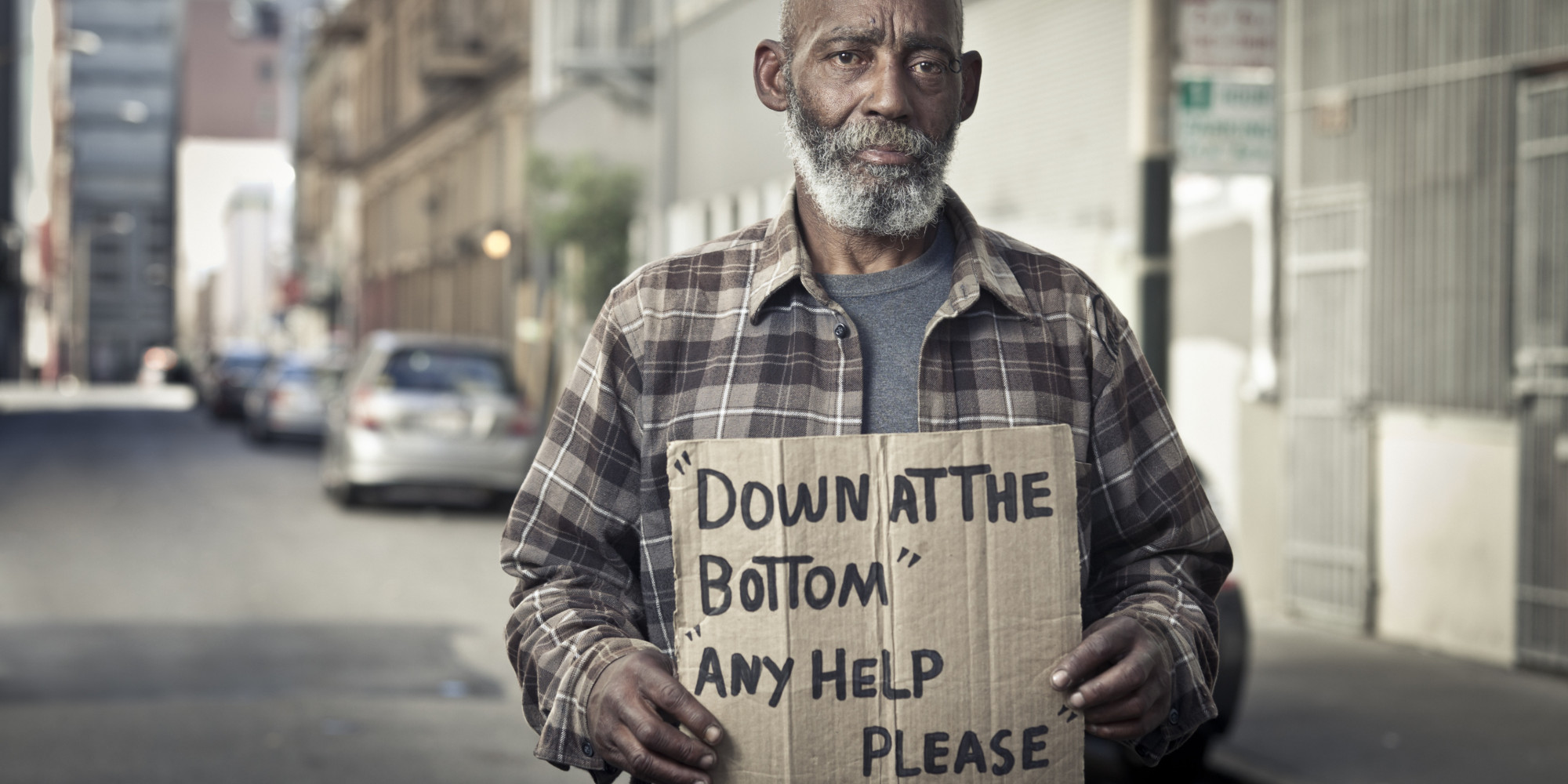
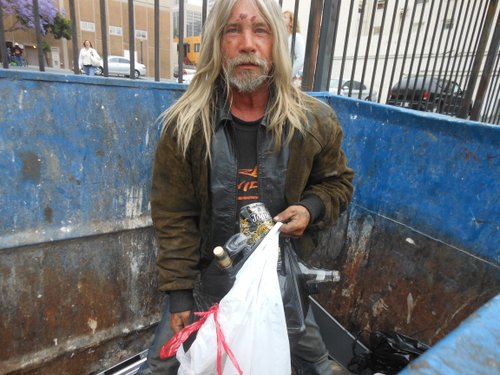
Do you notice the differences?  The non-Americans were all obviously starving, that's one difference.  But the more obvious difference is that the non-Americans are with others, working with others, but the Americans are alone.  This is probably just a result of the style of the photographers, but it also reflects a reality both live with.  The poverty of Africa is a poverty of resource to certain communities.  The poverty of America is a poverty of community which results in scarcity.

The poverty of the homeless person or of the welfare mom or of the mentally ill is not a lack of food, but a lack of meaningful community.  Poverty is not primarily an economic reality.  Rather, it is a social reality that has an economic result.  The poverty of the third world is a poverty of a community.  The poverty of the United States is a poverty of individuals.

The poverty of the United States, which might also include starvation, but certainly includes dangers of hypothermia and dehydration and sickness due to stress and unsanitary conditions, but also has an added layer of daily rejection from society.  

Not only is a poor individual in the US facing a lack of their survival needs, but they also have people telling them how bad they are, forcing them to move on a regular basis, assumptions that they are criminal and people telling them how they are not doing enough.  They are rejected by a whole society, outcasts from community, forced to not only be poor, but to be isolated.

I am not sure which poverty is worse. 

Wednesday, July 25, 2012

Why Punish the Poor?


There may be  a knee-jerk reaction to my title: “What do you mean we punish the poor?  We give to each person what they deserve.  We treat everyone the same.”

There are many situations in which our society treats everyone the same and so we punish the poor.  For instance, if someone pays their utility bill late, there is an additional fee put on that bill.  This does not punish those who have the money to pay it, except perhaps a slap on the wrist.  No, the one whom it truly punishes is the poor person who is unable to pay the bill in the first place.  If the bill is a water bill, and that payment lapses long enough, then the water company must contact the city if there are children in the house, and the children must be taken away.  Only the poor are punished like that.

Only the poor have their means of surviving taken away.  Many communities put restrictions on recycling cans, on busking, on begging, on entering dumpsters, even on offering free meals to the poor.   These are not restrictions because of harm to the community or because of environmental harm to the earth, but simply because the offenders are poor.  The fact that most communities make it illegal to be homeless is an indication that it is the poor that are punished, simply because they are poor.

It is more difficult to be poor, not simply because one is poor, but because society sees the poor as something to be punished.  For instance, banks have some of their largest fees for overdrawing an account… even though the banks are continuously changing their policies making it likely that the legalese-illiterate (that’s most of us) whose bank accounts are on the edge (that’s the poor) will fall prey to their fees. 

Now perhaps the banks aren’t interested in punishing the poor.  Perhaps they just see a vulnerable population that they can make money off of.  But one way or another, society makes it more difficult one a poor person than one who has sufficient funds to function in this society.  Many consider that our society is easy on the poor, and makes their lives too easy, too cush, living on welfare and taking it easy.  However, it has been shown that rarely is it possible to live housed and fed on welfare, even as one cannot live housed and fed on minimum wage.  The poor don’t have it easy.  And there are many societal obstacles to making it easier.

Why is this?  Why do many feel that the poor should be disciplined and treated “poorly”? 

Discomfort
The main reason we punish the poor, is because, for many of our society, the poor punish them.  First of all, the poor make our society look bad, as if our society has done something wrong by having the poor.  “Of course”, many think, “our society is well-functioning.  So the poor don’t need to be there.  But there they are, the blight on our economic statistics, every year. “  For some people, the poor make them feel guilty, as if they were doing something wrong, but when they search their deepest heart, they can’t find that they’ve done anything wrong.   For others, the poor, especially the poor who display themselves publically (such as the homeless or beggars) just makes one feel uncomfortable, and even embarrassed.  Not embarrassed for themselves, but embarrassed that they have to be watching this poor person.

In our intuitive moral systems, those who punish us, even if they did not intend to punish us, deserve to be punished back.  Those who make us feel uncomfortable or guilty should be punished for imposing those feelings on us.  A study in Brown University shows that we desire to punish those who cause harm, even if the harm is mostly accidental.  http://brown.edu/Research/Cushman-Lab/docs/cushman&greene_2011a.pdf?PHPSESSID=4cdd560f5c7168d8264dfde8164ad78a

In the end, many don’t care about the causes of poor.  If poverty makes us feel inadequate, there must be punishment on those who make us feel that way, since we don’t deserve it.

Reasons
Because we feel justified to punish the poor, we then come up with reasons to punish others.  These reasons don’t have to be realistic or proven by experience or studies.  All they have to be is plausible, and they will be accepted.

Bill Cunningham said, "People are poor in America ... not because they lack money; they're poor because they lack values, morals and ethics. "  In a similar vein, Bill O’Reilly said, "You gotta look people in the eye and tell 'em they're irresponsible and lazy .... Because that's what poverty is, ladies and gentlemen.” 

These reasons, as feeble and unconfirmed as they are,  are accepted by a large percentage of the population, not because it explains poverty, but because it explains why people feel comfortable and justifies punishment and poor treatment of the poor. 

Teachable Moment
Finally, the solid reason to punish the poor is for the sake of discipline.  The poor are “lazy” and “ignorant” and so it is the responsibility of society to make things harder on the poor, to train them to be solid, hardworking citizens again.   One either learns the discipline of working hard in one’s poverty, and so receive the natural consequences of prosperity, or one deserves what poverty one gets.  It doesn’t matter that the studies show that the poor work just as hard as any other segment of society.  It doesn’t matter that poverty is usually accompanied by depression and to put a hardship on a depressed person is an invitation for them to give up.  The ones who give up are considered “lazy” and so deserving of starvation, homelessness and receiving a social stigma. 

What can our society do to provide opportunities for the poor, not blocks or stigmas?  Perhaps we can provide work projects for people to get on their feet, not more difficulties?  

Wednesday, October 15, 2008

How To End Poverty 3

 
Posted by Picasa


Okay, let’s get serious about this. How DO we deal with poverty?

First of all, we need to understand what poverty is. There are two main categories of poverty, which greatly overlap. There is the poverty that is being physically destitute. This is the common kind of poverty we think of: people who are hungry, who have no where to live, who have no warmth, who have no safe drinking water, who are wracked by disease. Those who are destroyed because of their lack of physical needs.

The second is like the first: social poverty. This is a state of separation, of rejection, of outcastness. These are the poor who the mainstream culture of one’s society rejects, for one reason or another. Usually, however, they are rejected because they do not accept some major, unwritten law of the mainstream culture. They are too loud or too quiet. They don’t participate fully in the mainstream’s economic system. They don’t look like or dress like the mainstream. They have different cultural presuppositions.

This second class of the poor soon become the first class. They become destitute due to their social standing. And the mainstream feels good about these poor because, “They deserved it. If only they would…” (fill in cultural prejudice here) “… then they could live better.” So the mainstream convinces themselves that the poor are worthy to be poor and they deserve their benefits and judgments.

Another result of this cycle is fear. When one culture separates from another, then they tend to fear each other. The mainstream begins to see the outcast as the root of many of the evils of their society and the outcast sees in the face of every mainstream person the last mainstream person who abused them. This fear becomes prejudice and that prejudice becomes a cycle of mutual destruction.

How do we end this cycle?

First of all, the mainstream culture needs to associate with the outcast culture. If this happens, then the mainstream culture will realize, over time, that the outcast culture aren’t so bad after all. Perhaps they act differently, and hold some different opinions, but that doesn’t make them bad people. That even if they may not be as “good” as those of their own culture, then at least they shouldn’t be feared. Once we get past the fear, then we can perhaps get to the point where representatives of the two cultures could actually assist each other and support each other.

The difficulty is, how to get the two sides to overcome their fear? They need two things: 1. A neutral ground where they both feel safe to meet. And 2. A mediator that understands the cultural presuppositions of both sides and is willing to teach both sides about the social needs of the other without putting down either side.

If we end cultural superiority, then we will end most poverty. If the mainstream and the ruling elite understand the life and worldview of the poor outcast, then we are ready to welcome each person as they are.