Showing posts with label conflict. Show all posts

Wednesday, May 16, 2012

Partnering With the Police: Dealing with Conflict in Christian Ministry Part 6


For most of us who are middle class, the police are a symbol of security and order in the community.  If there is disorder, we might have a tendency to call the police immediately to make peace.  We feel that their uniform itself is a symbol of authority and security and people are more apt to listen to an officer than a simple citizen.

However, a ministry in which conflict is likely is going to be a ministry among the outcast of society—gangs, the mentally ill, the homeless, immigrants and others.  Among these groups, the police are those who judge and attack, who are not the defenders of security, but the creators of disorder.

Both perspectives have their points.  The police, ideally, are supposed to protect all citizens, and they do well in bringing security to homogeneous communities.  However, some, even if only a few, police officers have made themselves the enemies of the outcast, seeing them not as citizens but as “bad guys” and they treat them accordingly.

Unfortunately, what has happened is that the outcast and some police officers are both guilty of the same kind of stereotyping—judging a whole group for the actions of some.  Ideally, in time, the police and the outcast groups would be advised to discuss each other’s differences.

In the meantime, if we are doing any ministry to an outcast group, we have to recognize that the police are usually the opposite of a safe presence.  To call the police or to act like police is to betray the security of any outcast group.  This is not to say that the police should never be called, but it should be done sparingly, if at all.

The police should also be called rarely because to call them for any difficult conflict is to encourage the police to see the ministry as a target for problems, and the stereotyping of the group you’re ministering to would perpetuate.

And finally, the police should rarely be called because they have a different philosophy than a church ministry.  The job of the police is to keep citizens safe, in whatever way possible, and this is usually done by catching people who disrupt that safety and locking them up.  This is an appropriate and fair task for civil servants.  On the other hand, a church ministry that connects with the outcast is about re-appropriating the outcast and creating a place for them to experience the mercy of Christ.  This is a noble task, but the police would be the first to admit, honestly, that it is not a safe task.  Thus, it could be said (and it has been said by some) that the two tasks are the antithesis of each other—the police exile bad guys and the church tries to integrate them.  Both tasks are essential, but it is difficult for them to work together.

            If we are running a fairly large ministry for an outcast population, it might be good to communicate to the police about the ministry.  The police need to know that there will be a group of those who they are concerned about on the church grounds.  They also need to know that the church workers will be doing their best to create a safe place, both for the church and for the neighborhood.  And that because the church itself will be providing their own security, most of the time police presence will be unnecessary.  However, if there is a serious concern, then the church workers will contact the police themselves.

            The police will think that our ministry and the steps for deescalating conflict puts us in unnecessary danger.  Their training focuses on self-protection and stabilizing any situation.  A church ministry instead focuses on offering mercy, calling toward repentance, and loving those who are our enemies.  From a police perspective, this is dangerous business.  And perhaps it is.

            To prevent it being necessary for police to come, we will have to be proactive to prevent conflict.  This might mean acting as mediators between those who are heading toward conflict.  It certainly means following the steps of deescalating conflict.  And it will also mean that we will, on occasion have to put ourselves in harms way to protect others.

            On occasion the police will come on their own.  Perhaps they will see activity that they think could be illegal.  Perhaps a neighbor will call the police if they see a conflict that we will deal with ourselves.  When the police come, we need to politely identify ourselves, and answer their questions truthfully.  We need to encourage them to limit their contact to only those whom they are concerned with.  If some folks get into a fight, it is best for them to be off the church grounds before the police arrive.  This is all to help those who come to the ministry feel that they are safe without police involvement.

            Finally, there are some situations in which the police might be called.  If someone is continually threatening church workers or the facilities, then it may be necessary to call the police to get the person off of the church grounds.  Because the ministry of the church is to be focused on mercy, not judgment, then it is best to just ask the police to have the person go off of the church grounds, but not to press charges.  In this way, those who cause problems see that violence will not be tolerated, but that the church is not concerned with getting any vengeance.

De-escalating Conflict: Dealing with Conflict in Christian Ministry Part 5


The goal within a conflict in a church ministry is not to provide justice through judgment.  Justice, ultimately, is God’s task, to offer the perfect balance of justice and mercy to all men.  Being human, full of human motivation and reactions, our balance between justice and mercy is a bit off-kilter.  Our purpose, again, is to create a place of safety for everyone.  The best way to create safety is not to have a context of crime-and-punishment, but a context of repentance and reconciliation.  This means that the ideal, although not always realized, is to give anyone who is in conflict a place of safety because of their neccessity to have a space apart from the usual actions of the world.  If someone acts in opposition to the rules of the ministry, the main goal is not to punish them for their wrong action, but to convince them that such action is in opposition to everyone’s good.

How to respond to broken rules or conflict:
Patience—First of all, the Spirit fruit of patience is necessary.  Conflict is rarely resolved quickly, and it takes as long as it takes.  If a person is belligerent, then the leader must have “long-suffering” (to use the KJV term) with the one confronting them in order to have the success of bringing peace.  Part of this patience is that we invite them to give us their perspective of what happened.

Approaching Privately— It is best to speak to each person involved in a conflict separately.  Everyone needs to speak their perspective, but in the midst of a conflict, no one is able to hear the other person’s perspective.  Also, if someone is doing something inappropriate, it is best to confront them about it without adding to their shame by confronting them in front of their friends—especially because being in front of their friends might encourage them to act with bravado instead of thinking about the larger perspective.

Listening—In order for us to understand the conflict, we must listen to the reason of the person who is initiating the conflict.  The goal of listening is twofold.  First of all, if we are going to make a right judgment of the situation, we must understand the full context, and that will only be done by listening to whoever is causing the conflict.  Secondly, we need for those who are causing the conflict to feel heard and understood.  Thus, we are not listening as a goal in and of itself, but we are responding to what the other person is saying, and asking appropriate, not leading, questions.  When they feel understood and heard, we can move on to responding.

Objectivity—It is important in a conflict between two participants that the leader not take sides.  The participant must see that the leader is “no respecter of persons”, willing to look at a conflict from both sides.  This means that we need to consider what this conflict means from all parties involved and to speak to each of them from their perspective.  We also need to see that there is almost never a single wrong party in a conflict.  It takes one person to begin a conflict, but it takes more than one to continue it.  It's not our place to place blame, but to create a safe place for everyone.  This means that whomever took part in the conflict must be spoken to, fairly, about their part in perpetuating it.  Also, objectivity means that we cannot take the sides of any of our co-leaders who have perpetuated the conflict.  If any leader—even ourselves!— is involved in aggressive behavior, we must apologize and make no excuses for them because they are a leader.

Find Agreement—One way to quickly defuse a conflict is to find something to agree on with each person you are dealing with.  You can tell someone that you understand their perspective or that you agree that what was done to them was wrong, or just some part of what they said.  To agree with them is to defuse any idea that you are enemies.  Instead, you have made a connection with them and they will be more ready to listen to you.

Humor—Another way to defuse a situation is to use humor in speaking.  Not humor at anyone’s expense, but if you can speak lightly, it makes the situation less heavy and eases the minds of those involved.

Speaking for Peace—What response we give is based on two perspectives—first of all, their point of view, and also the perspective of the community.  Our response to them needs to recognize their needs and speak to them from their understanding of what happened.  Then we need to bring them into the larger perspective of the community, and how their actions aren’t appropriate for everyone else.  A very few people won’t care about others or their needs, but this is rare.  When we speak to them about this, we need to be gentle, remembering that resolving conflict is a part of the ministry to everyone involved, including those who cause the conflict.

Disciplining— For some smaller rules (such as blasphemy) a gentle (even humorous) reprimand is enough.  But if someone has broken a serious rule—stealing, violence or aggressiveness, or selling drugs for example—then there should be a discipline that is appropriate.  If someone is loudly threatening someone else, then they might be asked to leave for the day.  If a person acts with violence, they might be asked to leave for longer.  The reason for discipline is to communicate to the whole community that everyone’s security is important and to communicate that certain actions cannot be allowed in this safe place.  For someone who knows that they have done something very inappropriate for the church, they might actually appreciate a small amount of discipline as a kind of penance.  Again, just make sure that the discipline is appropriate with the rule broken.

How To Increase Conflict: Dealing with Conflict in Christian Ministry, Part 4


If a conflict does occur, that either breaks or leads to the breaking one of the rules, then a leader should be involved.  How the leader is involved will determine whether the conflict will increase or decrease.  If a conflict escalates, then it will become a fire that will spread, and the initial conflict will become a continuing problem, over a long period of time, among more and more people.

Expecting Unearned Respect/Obedience—Everyone has different ideas of how leadership should behave, and how to behave toward leadership.  In some cultures, authority is to be respected without question.  However, in other cultures, authority is only to be granted respect if they are deserving of that respect.  This does not mean that the non-authoritative cultures disrespect authority, they just expect those in authority to earn their respect, through peacemaking.  To act as if respect is to be deserved, not earned, is to set up a context in which a conflict of values is already present.
Escalating responses: “Don’t talk to me that way!  Do you know who I am?”

Undeserved judgment—If a person feels unfairly judged, then conflict will be seriously increased.  Not all judgments are considered unfair.  If a person gets into a fight on church property and is asked to leave, they will probably accept the discipline.  But if their side is not heard, or if they are given a discipline that is excessive to their action (permanent exclusion for a single event, for example), then the conflict will rapidly increase.  Judging the wrong person, or for the wrong motives or with an excessive punishment, will encourage a person to act out against how they are being treated, because there is no reason not to.  To avoid this situation, a person should be listened to carefully, and the viewpoint of the leader should be explained carefully, especially the reason for any discipline.
Escalating responses: “You obviously don’t know how to treat others with respect.”

Excessive demands—If a ministry has too many policies or requirements on their participants, mistakes will be made, for everyone is human.  The participants may not understand which policies are more significant than others, and lines may be crossed.  It is a mistake to take every bad situation in a ministry as an excuse for a new policy.  Too many rules, and soon it will be impossible not to break a rule.  Then there will be conflict at any correction, because the ministry will feel constricting.  Along these lines, having an extreme punishment for an offense will make the whole place feel insecure.  One ministry I know shuts the whole program down if one person gets out of line. So everyone is punished for the actions of one.
Escalating response: “Because you broke the rule of talking too loud, you’ll be excluded from the program for 30 days.”

Misdirected anger—Anger isn’t necessarily a cause of conflict.  If anger is displayed against a common oppositional factor—such as an unjust system—then anger can be useful in building a bridge between ourselves and the one in conflict.  However, if the leader displays anger against the one in conflict, then human nature demands that anger be reciprocated.  The improper response to anger is anger, and this creates or increases enmity.  As Christian leaders, we need to remember that the true enemy is not the person before us, but the spiritual forces of darkness that are causing strife.
Escalating response—“Get out of here, just don’t have anything to do with me!”

Disrespect—The very worst action to take is to disrespect any participant in the ministry.  To speak disrespectfully to one in the church ministry is to shame them before others, and to make a judgment against them.  Disrespectful speech include insults, snap judgments, or disregarding another’s concerns.
Escalating response: “What an idiot!”

Violence—The one thing that should never be done by church leadership is violence or threats against a participant.  If this is activity that we do not want the participants to engage in, then the same rule must apply to the leaders.  If violent action must be done for safety’s sake, then let the police be called (but first see the section on the police, part 6).

Avoiding all of these conflict escalators is especially difficult if these are the same attitudes and actions being used against the leaders.  As mentioned above, the normal human reaction is to respond in kind.  This is one of the joys of Christian leadership: that when despised, we will not despise in kind; that when persecuted, we will not persecute back.  It seems impossible to endure this, at times—to be more than any human can handle.  This is one of the reasons that Christian leadership is not for everyone.  For the Christian leader must expect to be confronted wrongly, but to respond in peace and gentleness.  This is difficult, but through dependence on the Holy Spirit, not impossible. (James 3:18; Galatians 5:19-26).

A Different Kind of Leadership: Dealing with Conflict in Christian Ministry Part 1 Part 1


We're all brothers, right?

As a Christian leader, we often have to deal with security issues, conflict and sometimes belligerence within the church.  As a church does serious outreach and attempts to connect with cultures outside of the church culture, there are often more opportunities for conflict and more possibilities that violence might erupt in or against the church.

            Our first impulse is to protect and defend the church community, and this impulse is good.  We all want to do our best to protect God’s people and we all hate to see violence in a house of God.  When these issues come to the forefront, we often find that we're unprepared to deal with the conflict, belligerence or violence, not only because we've rarely had to deal with it, but because we've never really thought about such events happening within a church.  However, churches need to think about these issues now, the more so as anti-Christian sentiment rises.

            It is important for us to consider what we would do as church leaders if belligerence or violence occurs in our church, how we can best prevent such situations from occurring, how to de-escalate such situations and what is the best way to deal with these situations as followers of Jesus.

I. The Foundation of Dealing With Conflict
There are three passages that can offer us a foundation, as leaders, for our dealing with the conflict  of those whom we have in our churches as guests.  These ancient texts—two from Jesus and one from Paul—can help us learn how to deal with conflict as followers of Jesus, rather than in the everyday manner.

Letting another succeed
 1.  A Different Kind of Leadership
And He said to them, "The kings of the Gentiles lord it over them; and those who have authority over them are called 'Benefactors.'  But it is not this way with you, but the one who is the greatest among you must become like the youngest, and the leader like the servant. For who is greater, the one who reclines at the table or the one who serves? Is it not the one who reclines at the table? But I am among you as the one who serves."  Luke 22:25-27

First of all, our leadership style is to be like Jesus’ and not like the world around us.  The world focuses on security or on how leadership can benefit oneself.  Jesus says that imitating Him in leadership means that we are always looking to the benefit of those whom we are leading.  A leader is not meant to just prevent anxiety in themselves or others, but to primarily act for the good of those whom they lead.  If Jesus is our servant, willing to accept any humiliation so that we can obtain all the benefits He has to give, even so are we, as church leaders, supposed to allow ourselves to be humiliated, even hurt for the sake of others, as long as it is for their benefit.

This is a difficult concept to accept for oneself, but it is the basis of Christian leadership.  Not to do things for one’s own sake, but to sacrifice all for the sake of the other.

2.  Benefiting Those Who Hurt Us
"But I say to you who hear, love your enemies, do good to those who hate you, bless those who curse you, pray for those who mistreat you.  Whoever hits you on the cheek, offer him the other also; and whoever takes away your coat, do not withhold your shirt from him either. Give to everyone who asks of you, and whoever takes away what is yours, do not demand it back. Treat others the same way you want them to treat you. If you love those who love you, what credit is that to you? For even sinners love those who love them. If you do good to those who do good to you, what credit is that to you? For even sinners do the same. If you lend to those from whom you expect to receive, what credit is that to you? Even sinners lend to sinners in order to receive back the same amount. But love your enemies, and do good, and lend, expecting nothing in return; and your reward will be great, and you will be sons of the Most High; for He Himself is kind to ungrateful and evil men.  Be merciful, just as your Father is merciful."   Luke 6:27-36

Again, in general, dealing with those who harm us, we must act like God and His Son Jesus.  An “enemy” is not one whom we declare to be enemies, but those who do us harm, for whatever reason.  Jesus is saying that instead of giving harm back to those who harm us, we are to love.  Love, simply stated, is acting for the benefit of those in need.  So when someone harms us, we are to look at them as someone in need.  Someone who is deficient in some way.  Someone who could use our help.  The question is, what is the best way that we can benefit a person who has done us harm?

            Jesus then associates this one characteristic—benefiting those who do us harm—with God’s behavior that we should imitate.  And He associates it with a basic characteristic of the Christian life, Love. If all people love, then what greater command does Jesus give to those who follow Him?  He commands us to love all those who are the most unlovely, to love without exception.  So if someone threatens us, hits us or even shoots us, we are to consider their benefit, as well as the benefit of those whom we are protecting.

To be continued...

Wednesday, March 24, 2010

Partnering With Police Wisely

For most of us who are middle class, the police are a symbol of security and order in the community. If there is disorder, we might have a tendency to call the police immediately to make peace. We feel that their uniform itself is a symbol of authority and security and people are more apt to listen to an officer than a simple citizen.

However, a ministry in which conflict is likely is going to be a ministry among the outcast of society—gangs, the mentally ill, the homeless, immigrants and others. Among these groups, the police are those who judge and attack, who are not the defenders of security, but the creators of disorder.

Both perspectives have their points. The police, ideally, are supposed to protect all citizens, and they do well in bringing security to homogeneous communities. However, some, even if only a few, police officers have made themselves the enemies of the outcast, seeing them as not citizens but as “bad guys” and they treat them accordingly.

Unfortunately, what has happened is that the outcast and some police officers are both guilty of the same kind of stereotyping—judging a whole group for the actions of some. Ideally, in time, the police and the outcast groups would be advised to discuss each other’s differences.
In the meantime, if we are doing any ministry to an outcast group, we have to recognize that the police are usually the opposite of a safe presence. To call the police or to act like police is to betray the security of any outcast group. This is not to say that the police should never be called, but it should be done sparingly, if at all.

The police should also be called rarely because to call them for any difficult conflict is to encourage the police to see the ministry as a target for problems, and the stereotyping of the group you’re ministering to would perpetuate.

And finally, the police should rarely be called because they have a different philosophy than a church ministry. The job of the police is to keep citizens safe, in whatever way possible, and this is usually done by catching people who disrupt that safety and locking them up. This is an appropriate and fair task for civil servants. On the other hand, a church ministry that connects with the outcast is about re-appropriating the outcast and creating a place for them to experience the mercy of Christ. This is a noble task, but the police would be the first to admit, honestly, that it is not a safe task. Thus, it could be said (and it has been said by some) that the two tasks are the antithesis of each other—the police exile bad guys and the church tries to integrate them. Both tasks are essential, but it is difficult for them to work together.

If we are running a fairly large ministry for an outcast population, it might be good to communicate to the police about the ministry. The police need to know that there will be a group of those who they are concerned about on the church grounds. They also need to know that the church workers will be doing their best to create a safe place, both for the church and for the neighborhood. And that because the church itself will be providing their own security, most of the time police presence will be unnecessary. However, if there is a serious concern, then the church workers will contact the police themselves.

The police will think that our ministry and the steps for deescalating conflict puts us in unnecessary danger. Their training focuses on self-protection and stabilizing any situation. A church ministry instead focuses on offering mercy, calling toward repentance, and loving those who are our enemies. From a police perspective, this is dangerous business. And perhaps it is.

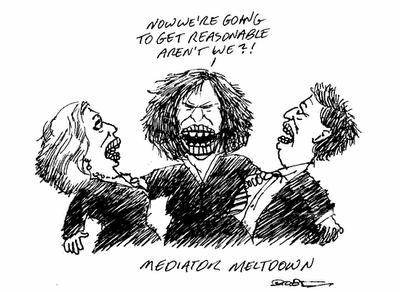
To prevent it being necessary for police to come, we will have to be proactive to prevent conflict. This might mean acting as mediators between those who are heading toward conflict. It certainly means following the steps of deescalating conflict. And it will also mean that we will, on occasion have to put ourselves in harms way to protect others.

On occasion the police will come on their own. Perhaps they will see activity that they think could be illegal. Perhaps a neighbor will call the police if they see a conflict that we will deal with ourselves. When the police come, we need to politely identify ourselves, and answer their questions truthfully. We need to encourage them to limit their contact to only those whom they are concerned with. If some folks get into a fight, it is best for them to be off the church grounds before the police arrive. This is all to help those who come to the ministry feel that they are safe without police involvement.

Finally, there are some situations in which the police might be called. If someone is continually threatening church workers or the facilities, then it may be necessary to call the police to get the person off of the church grounds. Because the ministry of the church is to be focused on mercy, not judgment, then it is best to just ask the police to have the person go off of the church grounds, but not to press charges. In this way, those who cause problems see that violence will not be tolerated, but that the church is not concerned with getting any vengeance.

Wednesday, March 17, 2010

How To De-Escalate Conflict

The goal in conflict in a church ministry is not to provide justice. Justice, ultimately, is God’s task, to offer the perfect balance of justice and mercy to all men. Being human, full of human motivation and reactions, our balance between justice and mercy is a bit off-kilter. Our purpose, again, is to create a place of safety for everyone. The best way to create safety is not to have a context of crime-and-punishment, but a context of repentance and reconciliation. This means that the ideal, although not always realized, is to sell anyone who is in conflict with creating a place of safety on the necessity to have a space apart from the usual actions of the world. That if someone acts in opposition to the rules of the ministry, the main goal is not to punish them for their wrong action, but to convince them that such action is in opposition to everyone’s good.

Patience—First of all, the Spirit fruit of patience is necessary. Conflict is rarely resolved quickly, and it takes as long as it takes. If a person is belligerent, then the leader must have “long-suffering” (to use the KJV term) with the one confronting them in order to have success of bringing peace. Part of this patience is that we invite them to give us their perspective of what happened.

Approaching Privately— It is best to speak to each person involved in a conflict separately. Everyone needs to speak their perspective, but in the midst of a conflict, no one is able to hear the other person’s perspective. Also, if someone is doing something inappropriate, it is best to confront them about it without adding to their shame by confronting them in front of their friends—especially because being in front of their friends might encourage them to act with bravado instead of thinking about the larger perspective.

Listening—In order for us to understand the conflict, we must listen to the reason of the person who is initiating the conflict. The goal of listening is twofold. First of all, if we are going to make a right judgment of the situation, we must understand the full context, and that will only be done by listening to whoever is causing the conflict. Secondly, we need for those who are causing the conflict to feel heard and understood. Thus, we are not listening quickly as a goal in and of itself, but we are responding to what the other person is saying, and asking appropriate, not leading, questions. When they feel understood and heard, we can move on to responding.

Objectivity—It is important in a conflict between two participants that the leader not take sides. The participant must see that the leader is “no respecter of persons”, willing to look at a conflict from both sides. This means that we need to consider what this conflict means from all parties involved and to speak to each of them from their perspective. We also need to see that there is almost never a single wrong party in a conflict. It takes one person to begin a conflict, but it takes more than one to continue it. It is not our place to place blame, but to create a safe place for everyone. This means that whoever took part in the conflict must be spoken to, fairly, about their part in perpetuating it. Also, objectivity means that we cannot take the sides of any of our co-leaders who perpetuated the conflict as well. If any leader—even ourselves!— is involved in aggressive behavior, we must apologize and make no excuses for them because they are a leader.

Find Agreement—One way to quickly defuse a conflict is to find something to agree with each person you are dealing with. You can tell someone that you understand their perspective or that you agree that what was done to them was wrong, or just some part of what they said. To agree with them is to defuse any idea that you are enemies. Instead, you have made a connection with them and they will be more ready to listen to you.

Humor—Another way to defuse a situation is to use humor in speaking. Not humor at anyone’s expense, but if you can speak lightly, it makes the situation less heavy and eases the minds of those involved.

Speaking for Peace—What response we give is based on two perspectives—first of all, their point of view, and also the perspective of the community. Our response to them needs to recognize their needs and speak to them from their understanding of what happened. Then we need to bring them into the larger perspective of the community, and how their actions aren’t appropriate for everyone else. A very few people won’t care about others or their needs, but this is rare. When we speak to them about this, we need to be gentle, remembering that resolving conflict is a part of the ministry to everyone involved, including those who cause the conflict.

Disciplining— For some smaller rules (such as blasphemy) a gentle (even humorous) reprimand is enough. But if someone has broken a serious rule—stealing, violence or aggressiveness, or selling drugs for example—then there should be a discipline that is appropriate. If someone is loudly threatening someone else, then they might be asked to leave for the day. If a person acts with violence, they might be asked to leave for longer. The reason for discipline is to communicate to the whole community that everyone’s security is important and to communicate that certain actions cannot be allowed in this safe place. For someone who knows that they have done something very inappropriate for the church, they might actually appreciate a small amount of discipline as a kind of penance. Again, just make sure that the discipline is appropriate with the rule broken.

Sunday, March 14, 2010

How To Increase Conflict

If a conflict does occur that either breaks or leads to breaking one of the rules, then a leader should be involved. How the leader is involved will determine whether the conflict will increase or decrease. If a conflict escalates, then it will become a fire that will spread, and the initial conflict will become a continuing problem, over a long period of time, among more and more people.

Expecting Unearned Respect/Obedience—Everyone has different ideas of how leadership should behave, and how to behave toward leadership. In some cultures, authority is to be respected without question. However, in other cultures, authority is only to be granted respect if they are deserving of respect. This does not mean that the non-authoritative culture disrespects authority, they just expect authority to earn respect by being peacemaking. To act as if respect is to be deserved, not earned, is to set up a context in which a conflict of values is already present.
Escalating responses: “Don’t talk to me that way! Do you know who I am?”

Undeserved judgment—If a person feels unfairly judged, then conflict will be seriously increased. Not all judgments are considered unfair. If a person gets into a fight on church property and is asked to leave, they will probably accept the discipline. But if their side is not heard, or if they are given a discipline that is excessive to their action (permanent exclusion for a single event, for example), then the conflict will increase rapidly. Judging the wrong person, or for the wrong motives or with an excessive punishment will encourage a person to act how they are being treated, because there is no reason not to. To avoid this situation, a person should be listened to carefully, and the viewpoint of the leader should be explained carefully, especially the reason for any discipline.
Escalating responses: “You obviously don’t know how to treat others with respect.”

Excessive demands—If a ministry has too many policies or requirements on their participants, mistakes will be made, for everyone is human. The participants may not understand which policies are more significant than others, and lines may be crossed. It is a mistake to take every bad situation in a ministry as an excuse for a new policy. Too many rules, and soon it will be impossible not to break a rule. Then there will be conflict at any correction, because the ministry will feel constricting.
Escalating response: “Because you broke the rule of talking too loud, you’ll be excluded from the program for 30 days.”

Misdirected anger—Anger isn’t necessarily a cause of conflict. If anger is displayed against a common oppositional factor—such as an unjust system—then anger can be useful in building a bridge between one in conflict with oneself. However, if the leader displays anger against the one in conflict, then human nature demands that anger be reciprocated. The proper response to anger is anger, and this creates or increases enmity. As Christian leaders, we need to remember that the true enemy is not the person before us, but the spiritual forces of darkness that is causing strife.
Escalating response—“Get out of here, just don’t have anything to do with me!”

Disrespect—The very worst action to take is to disrespect any participant in the ministry. To speak disrespectfully to one in the church ministry is to shame them before others, and to make a judgment against them. Disrespectful speech include insults, snap judgments, or disregarding another’s concerns.
Escalating response: “What an idiot!”

Violence—The one thing that should never be done by church leadership is violence or threats against a participant. If this is activity that we do not want the participants to engage in, then the same rule must apply to the leaders. If violent action must be done for safety’s sake, then let the police be called (but first see the section on the police)

To avoid all of these conflict escalators is especially difficult if these are the same attitudes and actions being used against the leaders. As mentioned above, the normal human reaction is to respond in kind. This is one of the joys of Christian leadership: that despised, we will not despise in kind; that persecuted, we will not persecute back. It seems impossible to endure this, at times—to be more than any human can handle. This is one of the reasons that Christian leadership is not for everyone. For the Christian leader must expect to be confronted wrongly, but responds in peace and gentleness. This is difficult, but through dependence on the Holy Spirit, not impossible. (James 3; Galatians 5).

Saturday, March 13, 2010

Galatians 5 and Conflict

It is interesting that Paul makes two lists in Galatians 5 that are frequently quoted: the works of the flesh and the gifts of the Spirit. But a careful examination of the two lists shows that, more than anything else, Paul is contrasting those who increase conflict with those who are making peace in community. I’ll give each list, with just a little bit of editing (check it out yourself in Galatians 5, please), and you can see it yourself:
Introduction—“The whole law: ‘Love your neighbor as yourself. The opposite: biting and devouring each other.”
Works of the flesh:
Enmities
Strife
Jealousy
Outbursts of anger
Disputes
Dissensions
Factions
Envying
Those who practice such things will not inherit the kingdom of God.

Fruit of the Spirit:
Love
Joy (taking joy in others)
Peace (being at peace with all)
Patience
Kindness
Goodness
Faithfulness (keeping promises to others)
Gentleness
Self-control (Not being controlled by the list above)
Against such things there are no law.

Thus, those who are not of the kingdom are characterized by making strife, and those of the Spirit are characterized by love.

This means that in our ministry, if we create strife, then we are not acting in accord with the Spirit, but with the flesh, which will deny us the kingdom of God. If we create peace and joy and kindness-- even to those who are in opposition to us-- then we are likely acting according to the Spirit.

Friday, March 12, 2010

How To Deal With Violent Conflict as a Christian Leader: #1 Create A Safe Place

If being a Christian leader means loving our enemies and acting with benefit for all, how can we possibly protect all people when there is violence? How can we prevent harm from happening?

The most basic principle is that we need to realize that we cannot, ourselves, prevent all harm to those under us. Everyone, ultimately, is in the hands of God, and there can and will be harm done at times. For this reason, we must pray for protection for those under our care. And we must pray for the Holy Spirit to create peace in the place where we minister. Ultimately, it is up to God to create a place that is safe for everyone.

But there are things we can do, in the midst of being Christ-like that would provide protection, while causing to harm to anyone. Below are step by step ways to prevent violence in our places of worship and service, where we can practice our love of our neighbor.

First of all, in whatever context we are in, whether worship, service or benevolence, we need to let it be known that this is a place of safety for everyone. That our church is going to be a place in which everyone has the opportunity to be safe, which means that no one will be allowed to participate in actions that harm others, whether a church leader, a church member, a guest, a police officer or anyone else. All are to follow the same rules of safety.
In that, the church needs to adopt a set of simple rules that will allow the most basic level of safety and respect to others. Anawim—our church of the homeless and the mentally ill— and their programs have adopted five simple rules that everyone can remember and respect, especially in a church setting. Our rules are these:
1. No threats or violence
This includes not only the acting out of harm, but the verbal or non-verbal threat of harm.
2. No illegal drugs or alcohol on the premises
This allows those who are inebriated to participate in services, as long as they abide by the other rules. But the church is not to be a place in which one becomes inebriated.
3. No stealing or borrowing other’s possessions without permission
4. No sexual harassment
This allows all members of the community to feel safe from unwelcome sexual advances, whether verbal or non verbal.
5. No blasphemy
This is out of respect of the Owner of the property as well as the community that manages it. This is not a rule against low brow language, but rather using God’s name in a demeaning way.
If the rules are simple, then they can be remembered. Also, they should make sense to people that the rules would be imposed in any of God’s sanctuaries, not special to that facility.

Finally, to build a context of safety in the building, there must be trust built between the leaders of every service and those who are participating in it. This means that the leaders should attempt to get to know all the regulars of the service, so that if the rules need be enforced, there is a relationship on which one can build such enforcement on. If there is a place of communication and trust between the leadership and the participants, then when conflict does occur, then the leadership will know immediately and will be called upon to help deal with it. If no trust is built, then the leadership will be the last place where those involved in or observing conflict will go to, because they fear how the leadership will deal with conflict.

Wednesday, August 19, 2009

Dealing With Conflict

Something that happened last night might help people understand some of the difficulties of having large groups of the mentally ill or socially weak together.

Julie and Jim (pseudonyms being used here!) are a mixed race couple who have come to Gresham a number of times. I met them for a first time when we allowed people to stay overnight when the weather was so terrible. They were nice enough, good people, never causing any trouble. Julie was definately more friendly than Jim-- he definatly had a tough repuation to keep up, and we were a little different for him. At one point a rapper friend of mine-- Jesse-- showed up and he spent the whole time talking to Jim about rap music and various musical things. That was great for both of them.

So Julie and Jim showed up last night, ate, hang out during the movie, and they went out to smoke. No problem. Well, maybe a bit, because what they wanted to smoke was weed. In Anawim, we have a no drugs policy, and I want to make sure that we don't get in trouble for people having illegal substances. The last thing I want is the police around.

This is where John comes in. I really like John (what is it with these "j" names in this story? I guess it's just the way it is...), but he can be a real hothead sometimes. I've had trouble with him in the past with his anger, but it's always worked out. Lately he's really been seeking the Lord, realizing that God can really help him with his problems. He's been listening to the Spirit and receiving counsel from believers. There's been a huge amount of growth in him over the last few months.

Well, John was outside and saw Jim with his joint. John went up to him and said, in his slightly manic manner, "Hey, this is a church, and you shouldn't be doing that because it's disrespectful." Jim promply ignored him. So John continued, "You know that I'm trying to get clean and I don't need that kind of stuff around me." Julie's response is, "So, go somewhere else."

John gets pretty upset, so he comes in to me, whispering under the movie, "You know that there's these guys smoking weed over behind the church." I couldn't hear him well, but I caught at least that much, and I thought he was talking about a different guy, who has a medical marijuana card. I knew I'd have to approach him about it, but I also knew John. I knew that if I came right out, they'd feel judged. So give it some time and I'll talk to them next time. I told John, "Okay, thanks. I'll deal with it." And sat back down next to my daughter.

Well, that wasn't quick enough for John. So he went straight back out.

About ten minutes later, John comes back to me and says, clearly enflamed, "You know, you should listen to what I tell you. I had to go out there and deal with it myself and bitch slap that guy."

"What!?" I said (still kinda quietly, because of the movie. I walked out of the church and went to the back.

"They aren't there, now." Jeff says.

"What do you think you're doing? I'm trying to get this guy to follow Jesus, and you're going to use violence? That's a great way to bring someone to the Lord! I was going to bring it up to him gradually, so that we could have a peaceful situation-- but you just couldn't wait! You just need to let me deal with it!"

"Look, he was blowing smoke in my face, there wasn't anything I could do. So I yelled at them. I didn't touch them, or anything."

"So... when you said you 'bitch slapped' him, you were lying to me?"

"That's right."

I turned away, disgusted. Now I had a situation. I have some folks who may not want to come back because they might think that I sent Jeff out there to yell at them. And I've just yelled at John, and that might trigger his anger and he'll want to take it out on me. Great.

When I got home, Diver (finally, not a "j" name!) told me that he talked to the people involved, away from the church and explained that John just went off a bit. Diver said that they were okay. John called me today, and apologized for his overreaction. So I guess it's all okay.

I still have to deal with the weed issue, and I will. But at least I have a chance to do it, now, without losing folks who might be damaged by feeling judged for something they think is perfectly fine. Everything in Anawim is step by step, no huge leaps here.