Wednesday, April 24, 2013

Will Plant Trees for Food


The other day I saw an air guitarist earning his daily bread.  Or pizza, whatever.

He was on a street corner, holding a sign for a pizza place… it might have been Little Caesar’s or Pizza Hut.. and he was doing what street sign holders do—holding a sign.  Nothing special, except that the sign was in the shape of a rock guitar.  And instead of just holding the sign, or dancing around, or waving at us passers-by, he was rocking.  Yep, he was playing that air guitar for all it was worth.  As a former air guitarist, I really appreciated his work and that he was allowed to do it in public.  Nay, even encouraged.

It makes me consider the many occupations that might gain no heed were it not for forward-thinking employers.   Think of the many mimes hired by the Disney Company to dress in costumes and wander around their parks.  Think of the thousands of artists hired by animation companies (mostly in Korea, but still).  And the many English majors hired by fast food companies… I mean Huffington Post… I mean… wait, how do English majors earn any money?  Think of all the useless theology majors hired to be pastors.  That’s some innovative hiring.

Then I thought of all these folks I know with practical skills.  I know plumbers, electricians, handymen, landscapers, cooks, factory workers… all of whom are on the street.  These aren’t people who are lazy or stupid.  They are good workers and know their business.  But they can’t get work.  Some of them are poor businessmen.  Some of them moved when they should have stayed.  Some of them changed jobs when they should have remained at the one they were at.  Perhaps they made poor decisions.  But their skills are necessary, and they are essential for keeping our society running.  Yet they are left to languish on the street, not even knowing where they could possibly find employment because no one is hiring people who are on the street.

A new friend of mine told me his story the other day.  He was a union construction worker and made 23 dollars an hour.  He had a family, purchased a house and settled into a good middle class life.  He made an error when he passed the ownership of his house to his brother, as a financial decision.  His brother sold the house out from under him.  He then lost his family, and decided to try his hand in another state as a ranch hand.  They underpaid him and gave him horrible living conditions.  He decided to go back to his hometown, but there was nothing there for him.  His family didn’t want him, and he couldn’t find work.  Now he is on his own in a tent and he doesn’t know what to do with his life or even if he should continue to live.

Why can’t we find work for people with skills?  Perhaps their people skills are something to be desired, and perhaps they are not employable by corporations.  But shouldn’t the church be willing to do alternative hiring, to provide people with work who otherwise can’t find work?  If each person saying “get a job” were willing to hire, the number of homeless could be cut in half.

Tuesday, December 11, 2012

An Open Letter to Multnomah County


Commissioner:Kafoury:

In your October newsletter you reported about the commission about ending homelessness.

Some of the questions this group is wrestling with include, how do we meet new federal mandates to reduce shelter stays? In a time of limited resources, how do we prioritize who we can help? Do we prioritize by population, for example, should we prioritize families over individuals? Do we prioritize by vulnerability, focusing services on who is less likely to survive outside? Are some groups of people not able to access housing or shelter services and if so, how do we change that? How do we raise attention to this issue and get more people involved in the solution?
As a long time supporter of the homeless in Portland and especially Gresham for 18 years, I have a few things to note:

The only ethical way to reduce shelter stays is to transition people into permanent housing or into a safe context to stay where they will not be harassed.

One of the problems of "ending homelessness" is that we now have a population of the chronic homeless who are not ready or able to move into apartments over the long term.  We have folks who have been in chronic stress for years, who have lived outside, under a different moral/survival code than is found in apartments.  We have a number of people who are frankly claustrophobic or paranoid or both.  Apartments are not the answer for everyone.

My recommendation is to have a variety of options for housing.  To have trailer parks with community centers for laundry and showers and electrical plug-ins might be an option.  To have areas where people could build their own structures, similar to dignity village is another option.  These are less expensive options than building apartment buildings, and more likely to house the chronic homeless (some of the most problematic population).

Also, we need options in the outlying areas of the county.  Churches in East County are trying their best to meet the need of the chronic homeless and Human Solutions (with the county's support) is doing a great job to help homeless families.  But, as you know, it is only a scratch on the surface.  We need assistance providing more support and in finding more funding to provide for needs.  Right now, in St. Johns, there is almost nothing being done for that homeless population.  The 2010 Street Count shows that homelessness is not centralized in the county, but is widespread.  The homeless tend to remain near their home neighborhood.  The majority of the homeless are not transitory, but are home grown and so are our community's responsibility.  We need to provide local compassionate solutions within each neighborhood.  This is not costly, but it does require organization and flexibility in city policy.

Not all the homeless is able to access shelter simply because there isn't enough shelter to be had.  Even with the low numbers of homeless population, there isn't even close to enough shelters for all the homeless.  And many homeless do not want to stay in shelters.  They are crowded, people's items are stolen, and it is difficult for the homeless to sleep in such contexts.  It would be difficult for anyone to sleep on a cot surrounded by a bunch of strangers they didn't trust.  I would suggest that more but smaller shelters be established throughout the county, including more permanent ones.  Having homeless people parked in vehicles at churches is a possibility, if the churches could be convinced that their property would be safe.  But only a small population of the homeless have vehicles.  The rest need to have places that they can camp or public areas they can sleep, in groups of 10.  Again, this requires organization, but not necessarily a lot of finances.

I know that you and your office have done a lot to try to get churches involved.  And yet I can start an outreach to the homeless in St. Johns and I am speaking to a dozen churches, all looking for an opportunity to help the homeless population around them, but they were just waiting for someone to take initiative, to know what the possibilities were and how to contact the homeless.  Suddenly, in a few months, we have a group that are ready to take action now, providing shelter both during the day and on the coldest nights, providing food and giving resources.  If a reasonable plan is provided to churches with...yes, that word again.. some clear, simple organization, then there is an untapped population of volunteers that are ready to work

God bless you in your work.

Steve Kimes
Pastor of Anawim Christian Community

Monday, August 27, 2012

A Pastoral Evaluation

If you've been following this blog for any decent length of time (or have read my brief bio) you know that I'm a pastor to the homeless and the mentally ill.  There are only a few of us out there, so those of us who take on this task are really making it up as we go.

What does a homeless pastor do?  First, I suppose, we need to determine what a "pastor" does.  A pastor is a community leader, but each pastor brings her or his own gifts to the position, making the role suited to what he or she can do.  One pastor is good at counselling, another is good at teaching, another is good at organizing, another is good at vision.  Some pastors are charismatic, some are prayers, some are visitors, some are students of the word.  Every pastor leads a community according to their gifts and the community begins to be shaped according to those gifts.

That is especially true if the pastor is also a church planter.  For the whole life of a congregation, it bears the indelible stamp of the church planter. And every pastor after a church planter is compared to the first, for good or for ill.  The congregation is, in a sense, the model which a church planter MUST create by his or her passion and abilities, and is thus limited by this as well. The congregation might morph beyond that, but there is a central core that a church planter gives and it never shifts from that.

I am both a pastor and a church planter.  I have remained in Anawim not because I don't think that anyone else could lead Anawim, but because it is a full-plus time job with no salary. That requires more passion and commitment than pretty much anyone has for an organization that they didn't build themselves.
 
So how am I doing as a pastor, given this background?  Of course, I can't evaluate myself objectively... but who can?  My congregation for the most part sees me with starry eyes.  An outside evaluator would have to follow me around and know the goals involved.   Even another pastor might see pastoral work as different than I could make it.

In the end, I would say that I do a fine job with helping people survive, but a less-than-fine job with helping them thrive.  With very few financial resources, I had led my congregation to give meals to many, to give people shelter, to create the building blocks for peaceful community, to clothe and shower so many.  We have lead a number to the Lord and given many a place to worship when they had no where else that would welcome them as they were.  I have taught hundreds, perhaps thousands, the basics of the gospel, seeking God through Jesus.

As far as a seed-thrower, I do well.  I spread the building blocks of survival wide so that many might partake.  My real limitation in this has been finances.  We could have done so much more if we had received donations of more than $25,000 a year.   Yeah, it's true.  That's all we get.  I keep hoping and praying every year that we might receive more finances, but that's it.  We've done a lot with a donation base that wouldn't rise my family of five out from under the poverty line. (My family's personal income has been between 10 and 15 thousand a year, most of that money being made by my wife working for minimum wage part time at a laundromat).

My personality is such that if someone is in desperate need, I try my best to help them.  Jesus said, "Give to those who ask you," and have done this to my utmost.  I try to evaluate need and then to give people the building blocks of meeting that need.  We don't solve all of anyone's problems.  All we do is try to give them the basics to improve their lot.

And improve is what people have done.  People have survived.  People are living, eating, getting the gospel, finding community, getting shelter when it's particularly cold... but almost no one is thriving.  It is to my shame that after people survive in my church, they thrive somewhere else.  In another community, in another church, in another context.  I understand the principle of planting and watering.  I know that our part is necessary.  That to thrive one must first survive.  But I wish I could give someone more than just building blocks at times.

But, frankly, I don't know what else to do than to cast seed.  To help people survive.  To give them basics.  I've worked really hard at trying to understand my people and to give principles of thriving.  But, at least looking at results, that's beyond my capability.

I really believe I've done well with what I've been given.  Again, I'm not objective about this, I can't evaluate myself fairly.  But for who I am, for what resources I have, I think I've accomplished a lot.  I guess, just like so many people, I want more.  I want more for my people.  I want them to do better than they have.


Wednesday, July 25, 2012

Why Punish the Poor?


There may be  a knee-jerk reaction to my title: “What do you mean we punish the poor?  We give to each person what they deserve.  We treat everyone the same.”

There are many situations in which our society treats everyone the same and so we punish the poor.  For instance, if someone pays their utility bill late, there is an additional fee put on that bill.  This does not punish those who have the money to pay it, except perhaps a slap on the wrist.  No, the one whom it truly punishes is the poor person who is unable to pay the bill in the first place.  If the bill is a water bill, and that payment lapses long enough, then the water company must contact the city if there are children in the house, and the children must be taken away.  Only the poor are punished like that.

Only the poor have their means of surviving taken away.  Many communities put restrictions on recycling cans, on busking, on begging, on entering dumpsters, even on offering free meals to the poor.   These are not restrictions because of harm to the community or because of environmental harm to the earth, but simply because the offenders are poor.  The fact that most communities make it illegal to be homeless is an indication that it is the poor that are punished, simply because they are poor.

It is more difficult to be poor, not simply because one is poor, but because society sees the poor as something to be punished.  For instance, banks have some of their largest fees for overdrawing an account… even though the banks are continuously changing their policies making it likely that the legalese-illiterate (that’s most of us) whose bank accounts are on the edge (that’s the poor) will fall prey to their fees. 

Now perhaps the banks aren’t interested in punishing the poor.  Perhaps they just see a vulnerable population that they can make money off of.  But one way or another, society makes it more difficult one a poor person than one who has sufficient funds to function in this society.  Many consider that our society is easy on the poor, and makes their lives too easy, too cush, living on welfare and taking it easy.  However, it has been shown that rarely is it possible to live housed and fed on welfare, even as one cannot live housed and fed on minimum wage.  The poor don’t have it easy.  And there are many societal obstacles to making it easier.

Why is this?  Why do many feel that the poor should be disciplined and treated “poorly”? 

Discomfort
The main reason we punish the poor, is because, for many of our society, the poor punish them.  First of all, the poor make our society look bad, as if our society has done something wrong by having the poor.  “Of course”, many think, “our society is well-functioning.  So the poor don’t need to be there.  But there they are, the blight on our economic statistics, every year. “  For some people, the poor make them feel guilty, as if they were doing something wrong, but when they search their deepest heart, they can’t find that they’ve done anything wrong.   For others, the poor, especially the poor who display themselves publically (such as the homeless or beggars) just makes one feel uncomfortable, and even embarrassed.  Not embarrassed for themselves, but embarrassed that they have to be watching this poor person.

In our intuitive moral systems, those who punish us, even if they did not intend to punish us, deserve to be punished back.  Those who make us feel uncomfortable or guilty should be punished for imposing those feelings on us.  A study in Brown University shows that we desire to punish those who cause harm, even if the harm is mostly accidental.  http://brown.edu/Research/Cushman-Lab/docs/cushman&greene_2011a.pdf?PHPSESSID=4cdd560f5c7168d8264dfde8164ad78a

In the end, many don’t care about the causes of poor.  If poverty makes us feel inadequate, there must be punishment on those who make us feel that way, since we don’t deserve it.

Reasons
Because we feel justified to punish the poor, we then come up with reasons to punish others.  These reasons don’t have to be realistic or proven by experience or studies.  All they have to be is plausible, and they will be accepted.

Bill Cunningham said, "People are poor in America ... not because they lack money; they're poor because they lack values, morals and ethics. "  In a similar vein, Bill O’Reilly said, "You gotta look people in the eye and tell 'em they're irresponsible and lazy .... Because that's what poverty is, ladies and gentlemen.” 

These reasons, as feeble and unconfirmed as they are,  are accepted by a large percentage of the population, not because it explains poverty, but because it explains why people feel comfortable and justifies punishment and poor treatment of the poor. 

Teachable Moment
Finally, the solid reason to punish the poor is for the sake of discipline.  The poor are “lazy” and “ignorant” and so it is the responsibility of society to make things harder on the poor, to train them to be solid, hardworking citizens again.   One either learns the discipline of working hard in one’s poverty, and so receive the natural consequences of prosperity, or one deserves what poverty one gets.  It doesn’t matter that the studies show that the poor work just as hard as any other segment of society.  It doesn’t matter that poverty is usually accompanied by depression and to put a hardship on a depressed person is an invitation for them to give up.  The ones who give up are considered “lazy” and so deserving of starvation, homelessness and receiving a social stigma. 

What can our society do to provide opportunities for the poor, not blocks or stigmas?  Perhaps we can provide work projects for people to get on their feet, not more difficulties?  

Sunday, June 3, 2012

Dogs Save Lives

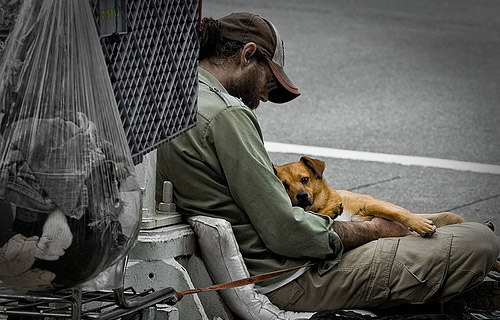
Many dogs save the lives of the homeless.

A dog can protect their human.
A dog can keep their human warm on a winter night.
A dog can be a loving irritant to help their human's character grow.
A dog can give their human family to love.
A dog can provide their human with someone to be responsible for and to take care of.
A dog can give friendship and love.

A dog is family.

A dog can be a reason to quit drugs or alcohol.
A dog can be a reason to control one's anger.
A dog can be a focus to develop love and compassion.

Support the homeless with pets.  It is good for the homeless.  It is good for the community.

Wednesday, May 30, 2012

Gratitude


In my business, I deal with a lot of donors and volunteers.  That’s really the lifeblood of work with the homeless.  We don’t have money to keep everyone fed and warm, so we seek donations of food and clothes.  And there is more work that our small group can do ourselves, so we seek volunteers to help us accomplish big tasks.

But there are rituals for donors and volunteers.  Donors usually want their donations to be more than a simple donation.  They’d like a receipt to mark their donation to take it off of their taxes.  Some would like their donation to be recognized in a newsletter or in our blog.  Many donors want to tell us specifically how to use the money, even if that isn’t our need at the time.

Volunteers really want the same thing.  They don’t want to be told what to do, or how to do something.  They want to tell you what they will do, and when to do it.  They want to do something you don’t need done, at times.  And, of course, they want your gratitude, and possibly a letter of recommendation for the hour of work they’ve given you.

Not all volunteers or donors are so insistent.  Most are wonderful, and gracious and so kind.  And I have to say, almost all of the homeless volunteers and donors are wonderful.  And this is because they are giving back.  They are grateful for the opportunity to give and to work, because they feel like they’ve paid a small back for all that they’ve received.  Sure, the clothes they donate may need to be cleaned and the service may, on occasion, need to be done again.  But the gracious attitude is one of the best things on earth.

"Who loves more, the one who has been granted much, or the one who has been granted little?  He who has been granted little, loves little."

Tuesday, May 29, 2012

Dysfunctional Families

A poem by Patty

(...when does it stop?)
(...how can the chain be broken?)
(...will I recognize "normal"?)

Generations of guilt;
Generation of pain;
We're promised sunshine...
We feel the rain
We shiver and shake
Now we're late,
With reprimand
They bind our hand;
Now... they cannot wait
Because of you...
The deal fell through
Too late to shine my shoes!
You know the rules...
Begone!... get off!
My ship of fools!
                        -PAST